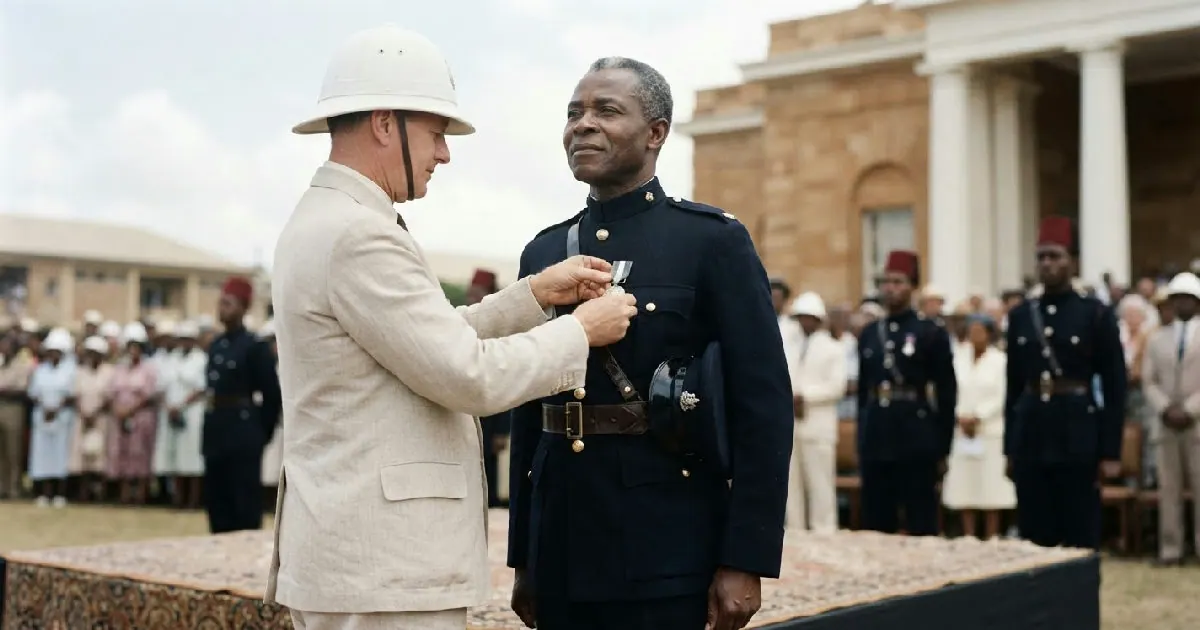
On June 1, 1953, Nigerian Assistant Superintendent Eugene Kenneth Keazor received the Colonial Police Medal for Meritorious Service, a prestigious award listed in The London Gazette during Queen Elizabeth II's coronation honours. This recognition marked Keazor as a trailblazer, a Nigerian officer who rose through the ranks typically reserved for expatriates, long before Nigeria gained independence. Keazor's achievement was a significant milestone in his career and a testament to his dedication and hard work.
Eugene Akosa Keazor was born in Obosi, Eastern Nigeria, in 1907 and joined the West African Constabulary Force around 1927. At that time, opportunities for indigenous officers were limited, but Keazor's exceptional abilities earned him a promotion to Inspector in 1930. The Colonial Police Medal was an official decoration from the British government for distinguished professional service within its colonial territories. Keazor's award validated his decades of service within a system not designed for his ascent.
Keazor's career trajectory did not stop with colonial recognition. By 1959, he achieved the rank of Assistant Commissioner of Police, making him the most senior African officer in the Nigeria Police Force while it was still under British command. As Nigeria approached independence on October 1, 1960, Keazor's career paralleled the nation's journey. He played a crucial role in shaping the institutions of a new sovereign state, and his expertise was critical in preparing the country to take full charge of its security apparatus.
In 1960, the year of Nigeria's independence, Keazor was called to an international stage, commanding the first Nigerian police contingent deployed for the United Nations Peacekeeping Mission to Congo-Kinshasa. This assignment underscored Nigeria's growing global role and the trust placed in its emerging leadership. Keazor's participation in the mission demonstrated his capabilities and preparedness to lead complex security operations.
After independence, Nigeria's policing system underwent a critical transformation. The 1960 Constitution preserved the Nigeria Police Force as a national institution, but it also outlined new relationships between federal and regional authorities. Keazor was appointed Commissioner of Police for the Eastern Region, overseeing a complex network of 62 police stations and posts. His role was pivotal in demonstrating that Nigerians could lead and manage large, complex security operations.
Keazor retired in 1964, concluding a career that spanned over three decades of profound change. He had served during the colonial era, received British honours, and then led a crucial regional command in the nascent years of an independent Nigeria. His contributions were instrumental in establishing a professional, indigenously led police force. Although Keazor did not become Nigeria's first indigenous Inspector-General of Police, his pioneering efforts paved the way for others.
Eugene Akosa Keazor's life embodies the spirit of a nation finding its feet. His professional journey underscores the often-unseen work of individuals who lay the groundwork for national sovereignty. His career demonstrated that Nigerians were capable of maintaining law and order and leading sophisticated police operations at both national and international levels. Keazor's legacy is a testament to the power of quiet, persistent work in achieving greatness.
Key points
- Eugene Keazor was awarded the Colonial Police Medal for Meritorious Service on June 1, 1953.
- Keazor achieved the rank of Assistant Commissioner of Police in 1959, making him the most senior African officer in the Nigeria Police Force.
- Keazor commanded the first Nigerian police contingent deployed for the United Nations Peacekeeping Mission to Congo-Kinshasa in 1960.