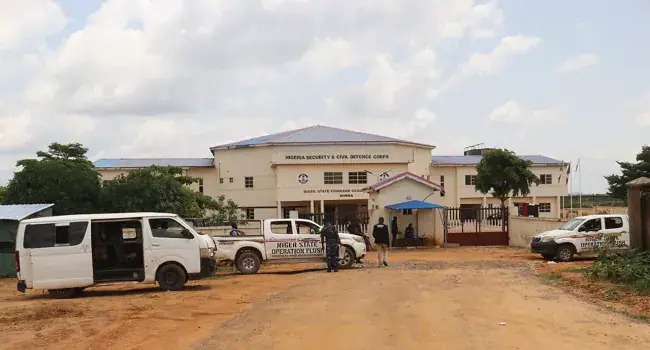
A federal panel of investigation in Nigeria has concluded that senior officers of the Nigeria Security and Civil Defence Corps (NSCDC) were responsible for the deaths of 33 detainees at a facility in Minna, Niger State. The Independent Investigation Committee's report detailed how officers authorised operations without clearance, ignored warnings of possible suffocation, and failed to intervene despite repeated cries for help. The committee attributed the cruel and degrading detention conditions leading to the deaths to the actions and negligence of the officers.
The committee found that NSCDC commandant Suberu Siyaka authorised operations against suspected illegal miners without an approved operational order or clearance from the NSCDC National Headquarters. Siyaka also bypassed the corps' zonal supervisory authority and did not involve the specialised Mining Marshal Unit stationed in Minna. The operations resulted in the arrest of 75 people, who were subsequently detained in overcrowded cells. The committee faulted Siyaka for failing to ensure proper supervision and lawful detention procedures.
The investigation revealed that an overcrowded detention cell held approximately 50 male detainees, including 17 children, despite being designed to accommodate 40 people. Chief Superintendent of Corps Sunday Oluwadare, who headed the command's Investigation Unit, was accused of facilitating unlawful detention and disregarding legal and medical warnings. He authorised the detention of suspects, including children, without complying with applicable procedures. The committee also identified two detainees held without remand warrants.
On the evening of 16 September, guards alerted Oluwadare to extreme heat inside the detention cell, but he left without directing officers to decongest the cell or take other effective measures. A legal officer had earlier warned that the suspected mining offence was bailable and raised concerns about the detention of minors. A medical worker also warned that overcrowding could cause suffocation, but these warnings were ignored. The committee recommended Oluwadare's dismissal and criminal prosecution.
The report attributed separate failures to Usman Ndamaka, a superintendent of corps in charge of cell guards, and Hassan Mohammed, an assistant superintendent of corps who served as the night guard. Ndamaka admitted that approximately 50 male detainees, including children, were confined in a cell that should accommodate about 20 people. He instructed Mohammed not to open the door without armed backup, warning that the detainees might be attempting to escape. Mohammed refused to open the door despite desperate cries and persistent banging from the cell.
The committee found that Mohammed neither opened the cell nor organised reinforcement to inspect it. Ndamaka also failed to respond to an emergency telephone call from Mohammed, allegedly because he was asleep. When officers opened the cell, they discovered that 33 detainees, including 14 children, had died. The committee faulted Ndamaka for issuing the instruction that prevented intervention, failing to respond to the emergency, and neglecting his supervisory responsibilities.
The committee recommended the dismissal of six NSCDC officers, including Siyaka, and their prosecution for murder, torture, inhumane and degrading treatment, and criminal negligence. The report was submitted to Interior Minister Olubunmi Tunji-Ojo on 27 October, following an investigation into the deaths on 16 and 17 September. The committee's conclusions are investigative findings, not criminal convictions.
Key points
- The Nigerian federal panel's investigation revealed that senior NSCDC officers were responsible for the deaths of 33 detainees in Niger State.
- The panel recommended the dismissal of six NSCDC officers and their prosecution for various crimes.
- The investigation found that the detention conditions leading to the deaths were a result of the actions and negligence of the NSCDC officers.