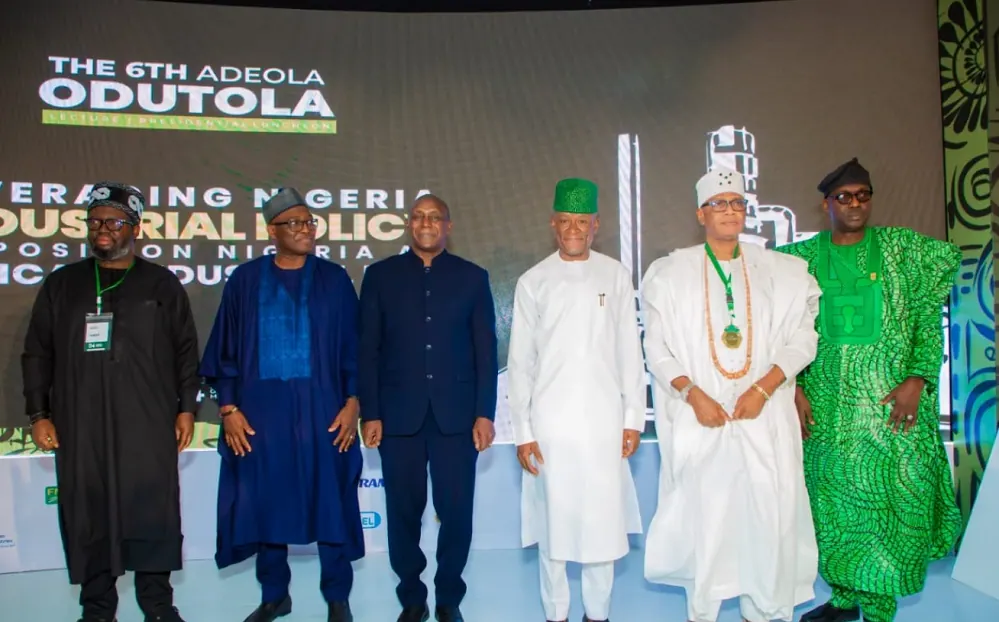
President Bola Ahmed Tinubu has assured manufacturers in Nigeria that his administration remains committed to the implementation of the National Industrial Policy (NIP). The policy aims to drive measurable and accountable improvements in Nigeria's industrial sector. Tinubu stated this at the sixth Adeola Odutola Lecture and Presidential Luncheon organised by the Manufacturers Association of Nigeria (MAN) in Lagos. The event was part of the 54th Annual General Meeting (AGM) of MAN.
The National Industrial Policy was unveiled in February and targets raising manufacturing's contribution to Gross Domestic Product (GDP) from 10 per cent to between 20-25 per cent by 2030. The policy is supported by industrial financing of up to five per cent of GDP. Tinubu, represented by the Minister of State for Industry, Sen. John Enoh, emphasized that the implementation of the NIP would be measured by factories reopened, capacity utilized, jobs created, exports shipped, and new factories established.
To ensure the policy's implementation, Tinubu has directed the Ministry of Industry, Trade and Investment, through the Industrial Revolution Working Group (IRWG), to hold quarterly delivery dialogues with MAN. These dialogues will enable manufacturers to monitor the policy's implementation and hold the government accountable. The IRWG brings together government, the Organised Private Sector (OPS), financiers, and development partners to work towards a common goal.
The President identified reliable power as a critical factor in the policy's success, noting that the cost of energy is a major determinant of production costs. He promised to prioritize gas for industry and work with the Bank of Industry (BOI) and the banking system to channel patient, affordable, long-term finance to the productive sector. This will enable manufacturers to access affordable financing and reduce production costs.
Tinubu also pledged to prioritize fair markets, trade facilitation, and improved security along industrial corridors. He urged manufacturers to reciprocate government's efforts by investing in production capacity and deepening backward integration. The President charged them with meeting international standards, training young Nigerians, and treating the African market as their home market.
Former Director General of the United Nations Industrial Development Organisation (UNIDO), Dr. Kandel K. Yumkella, described the theme of the lecture as "timely and forward-looking." He noted that Nigeria has the essential foundations of an industrial powerhouse but stressed that potential does not translate to performance. Yumkella identified reliable electricity as a critical challenge to Nigeria's industrial transformation.
The Manufacturers Association of Nigeria (MAN) has welcomed the National Industrial Policy, saying it provides a framework for addressing structural constraints that have limited industrial growth. Out-going MAN President, Meshioye, emphasized that the policy's significance depends on consistent implementation, institutional coordination, and measurable outcomes. The policy aims to position Nigeria as a leading industrial hub in Africa.
Key points
- The Nigerian government has assured manufacturers of its commitment to implementing the National Industrial Policy to drive improvements in the country's industrial sector.
- The policy targets raising manufacturing's contribution to GDP from 10 per cent to between 20-25 per cent by 2030.
- The implementation of the policy will be measured by factories reopened, capacity utilized, jobs created, exports shipped, and new factories established.