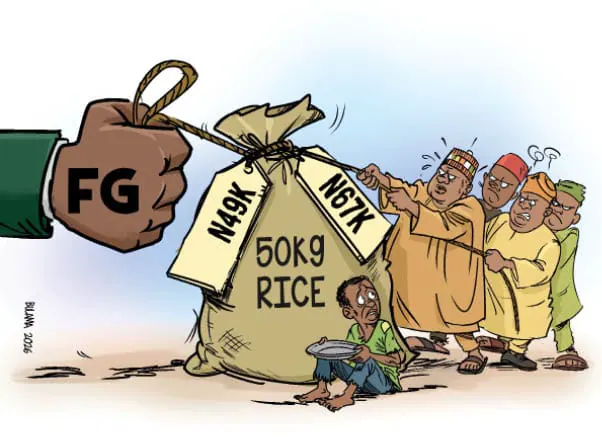
The Nigerian federal government and rice processors have expressed differing views on the price of milled rice in the country. The government claims that the current price, ranging from N60,000 to N67,000 for every 50 kilograms bag, is too high and should be reduced to a more reasonable range of N55,000 to N57,000. This issue was discussed at a meeting convened by the ministers of Agriculture and Food Security on October 6, 2026.
The meeting, attended by the president of the Rice Processors Association of Nigeria, Mohammed Abubakar Mai Fata, and other stakeholders, had a tense atmosphere with accusations and counter-accusations over the current price of rice. The ministers argued that their market survey and analysis showed an average production cost for a bag of rice of N49,389.23, making the current market price "too high and indiscriminate."
Senator Abubakar Kyari, the Minister of Agriculture and Food Security, stated that the government is not trying to control prices but wants to ensure that the prices are reasonable. He emphasized that the government has mechanisms to protect citizens' welfare while also considering farmers' and millers' welfare. The minister of state for agriculture, Dr Aliyu Sabi Abdullahi, alleged that there are "bad eggs" in the Rice Processors Association of Nigeria trying to sabotage the country.
Dr Abdullahi urged the association to discipline its members who engage in bad behavior and to autocorrect its systems to ensure integrity. He defended the government's position on the current price, stating that the ministry considered all cost drivers in the processors' production system, including waste and losses, and fixed costs. The permanent secretary of the ministry, Dr Marcus Olaniyi Ogunbiyi, also insisted that the current price is too high.
Mohammed Abubakar Maifata, the president of the Rice Processors Association of Nigeria, expressed frustration with the government, citing the importation of rice by some individuals as a major challenge. He claimed that this importation is adversely affecting local millers and making it difficult for them to compete. Maifata also pointed to the high cost of paddy, the primary raw material for rice processing, as a factor contributing to the instability in rice prices.
Maifata stated that the cost of paddy has increased due to factors such as the high cost of fertilizer and diesel, making it difficult for farmers to sell paddy at a lower price. He noted that at 20 percent moisture, farmers cannot sell a tonne of paddy for less than N500,000. However, the minister interjected, citing the survey carried out by the ministry, which showed that prices of paddy vary based on demand and supply.
The disagreement between the government and rice processors highlights the challenges facing Nigeria's rice industry. The government's efforts to reduce the price of rice and make it more affordable for citizens are pitted against the processors' concerns about the high cost of production and the impact of importation on their businesses.
Key points
- The Nigerian government and rice processors have disagreed on the price of milled rice.
- The government claims that the current price is excessive.
- The processors cite the high cost of paddy and importation as factors contributing to the high price of rice.