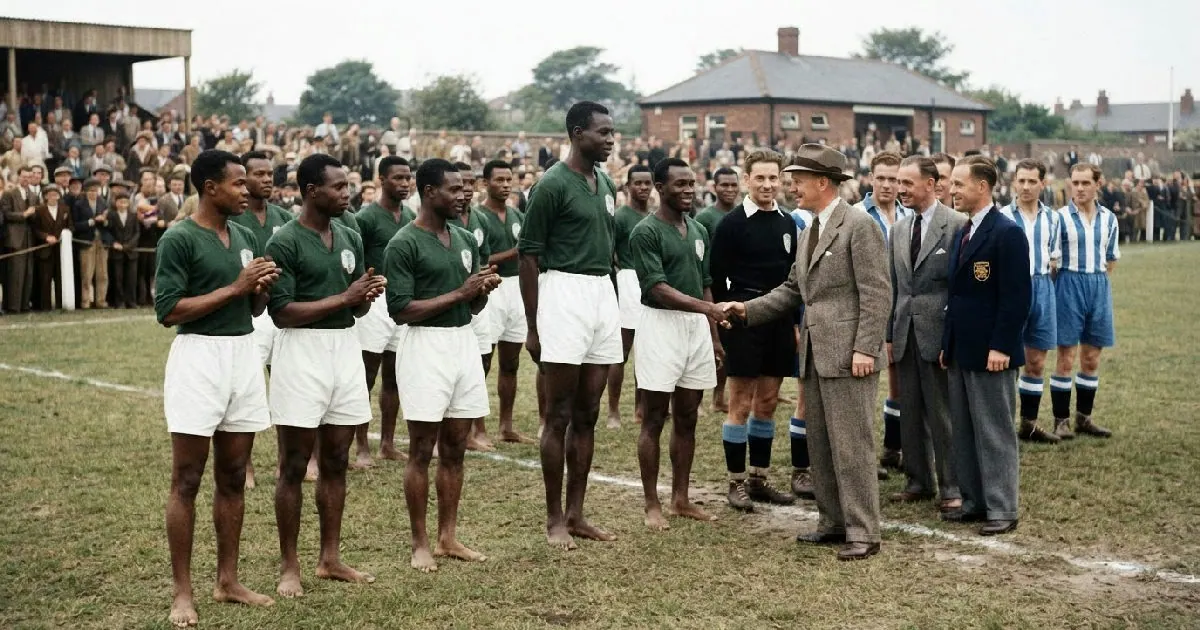
In the summer of 1949, eighteen Nigerian footballers embarked on a pioneering voyage to play a month of matches in Britain, challenging perceptions of African sport. The team, dubbed the “UK Tourists” or “Red Devils,” was organized by the Nigerian Football Association and comprised players from diverse professions, including civil servants, teachers, and railway workers. Led by captain Etim Henshaw, a marine engineering apprentice, the squad included future legend Teslim Balogun and talented forward Titus Okere.
The Nigerian team's journey began on August 16, 1949, aboard the RMSS Apapa, arriving in Liverpool on August 29 after a two-week sea voyage. The British press was startled by photographs of players with strapped, bare feet, sometimes with socks cut to expose their toes. This was a deliberate tactical choice, preferred on harder surfaces where it offered better ball control. The sight of players with taped toes stepping onto English pitches without footwear seemed to confirm initial biases, but the team was determined to compete.
The Nigerians' first match was against Marine Crosby FC at Rosset Park on August 31, 1949, before 6,000 spectators. The Nigerian side clinched a decisive 5-2 victory, dispelling any notion that they were merely there for entertainment. Marine Crosby donated £200 from the gate receipts to the Nigerian Football Association, acknowledging the competitive quality they had encountered. This win sent a clear message: these amateurs from a distant colony could play, and they could win.
The tour comprised nine matches against established English amateur clubs and representative sides. The “Red Devils” ultimately recorded two wins, two draws, and five losses. While not a clean sweep, the record reflected their ability to compete under unfamiliar and often challenging conditions. The team faced Bishop Auckland FC on September 3, losing 5-2, and Leytonstone FC on September 8, with a 2-1 defeat.
One of the tour's standout moments came on September 14, when Nigeria drew 2-2 against a Corinthian League XI. Teslim Balogun scored a late equalizer, demonstrating the team's resilience. However, the most substantial defeat occurred on September 21, against an Athenian League XI, where Nigeria lost 8-0. Heavy rain transformed the pitch into a muddy, slippery mess, exposing the limitations of barefoot play on soft ground.
The 1949 tour was more than just a series of games; it was a foundational moment for Nigerian football. It proved that Nigerian talent could not only travel abroad but also compete effectively. The tour directly opened doors for individual players, with Titus Okere becoming the first Nigerian to sign a professional contract with an English club, joining Swindon Town in 1953. Teslim Balogun followed suit, playing for Peterborough United, Skegness Town, and Queens Park Rangers.
The “UK Tourists” also influenced other African nations, encouraging teams like the Gold Coast (Ghana) in 1951 and Uganda in 1956 to undertake similar tours. Today, Nigerian footballers are household names across Europe's top leagues and international stages, with the Super Eagles winning the Africa Cup of Nations three times. This ubiquity makes it easy to forget how recent this global integration truly is, and the enduring image of the barefoot footballers who blazed the trail.
Key points
- The 1949 Nigerian UK tour challenged perceptions of African sport and paved the way for future generations of Nigerian footballers.
- The tour resulted in two wins, two draws, and five losses, demonstrating the team's ability to compete under unfamiliar conditions.
- The tour had a lasting impact on Nigerian football, influencing other African nations and opening doors for individual players to sign professional contracts with English clubs.