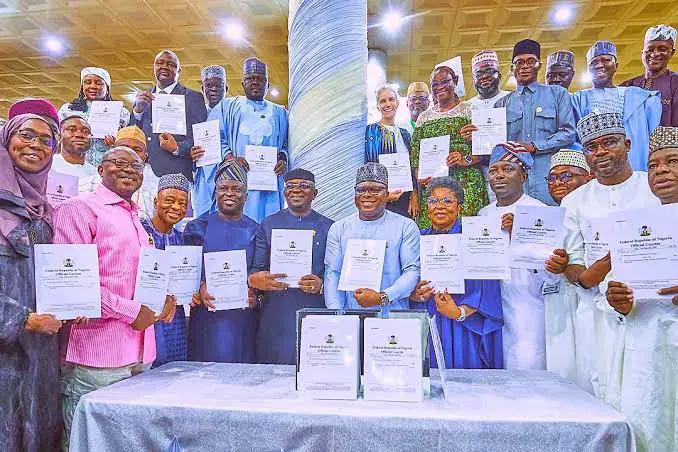
The Federal Government of Nigeria has unveiled a Presidential Executive Order on Open Defecation-Free (ODF) Nigeria by 2030. The order, signed by President Bola Tinubu, aims to strengthen the legal and institutional framework for ending open defecation. The Vice-President, Sen. Kashim Shettima, represented by the Senior Special Assistant to the President on Delivery and Coordination, Office of the Vice-President, Mr Akubo Adegbe, performed the unveiling in Abuja. This event marked the 2026 World Toilet Day and the seventh anniversary of the Clean Nigeria: Use the Toilet Campaign.
According to Shettima, the executive order reaffirms the Federal Government's commitment to ending open defecation. He stated that the order would strengthen coordination and advance collective efforts by governments and other stakeholders to achieve an ODF Nigeria by 2030. Nigeria has recorded ODF status in 185 Local Government Areas (LGAs), while Jigawa and Katsina have attained statewide ODF status since the campaign began in 2019. However, Shettima noted that the country still has significant work to do, with 774 LGAs.
The Minister of Water Resources and Sanitation, Prof. Joseph Utsev, said the campaign had evolved over seven years into a platform for policy coordination, institutional engagement, community mobilisation, and performance monitoring. Utsev mentioned that the government had strengthened its implementation framework through the Revised Clean Nigeria Strategy 2025–2030, which focuses on six strategic pillars. These pillars include enabling environment, partnerships and coordination, public finance, service delivery, advocacy and communication, and monitoring, evaluation, learning, and accountability.
The Minister identified the Clean Nigeria Real-Time Monitoring and Information System (CNC-RTMIS) as another achievement, saying it would improve data management, performance tracking, and accountability. He also mentioned that the revised Presidential Executive Order 009, signed by Tinubu, would reinforce stakeholder participation, private sector engagement, monitoring, and accountability. Utsev emphasized that adequate financing, community ownership, sustained behavioural change, multi-sectoral collaboration, and reliable data are essential to achieving and sustaining ODF status.
Emily Rand, UNICEF Chief of WASH, called for accelerated efforts to end open defecation and urged governments and stakeholders to strengthen sanitation financing, planning, and coordination. Rand requested that participants indicate by a show of hands whether they lived in ODF LGAs and whether their institutions had dedicated sanitation budgets. She also sought to know how many regularly coordinated with finance and planning departments, non-governmental organisations, the private sector, and other stakeholders.
The event included the presentation of ODF certificates to qualifying LGAs and the decoration of First Ladies as Clean Nigeria Campaign Ambassadors to promote sanitation advocacy and mobilisation. Goodwill messages were delivered by representatives of the Ministry of Youth Development, the Clean Nigeria Campaign WASH Ambassador, the Society for Water and Sanitation (NEWSAN), and Reckitt Benckiser, a global consumer health and hygiene company.
The Federal Government has urged private sector organisations to support efforts to end open defecation in Nigeria through their Corporate Social Responsibility (CSR) programmes. The Minister of Water Resources and Sanitation, Prof. Joseph Utsev, made the call at the 6th National Retreat for States on the Clean Nigeria Campaign (CNC) in Abuja. Utsev emphasized that sustainable sanitation required stronger collaboration among the Federal, State, and Local Governments, development partners, civil society organisations, and the private sector.
Key points
- The Nigerian government has set a goal to achieve open defecation-free status by 2030.
- The Presidential Executive Order aims to strengthen the legal and institutional framework for ending open defecation.
- Nigeria has recorded ODF status in 185 Local Government Areas, with Jigawa and Katsina attaining statewide ODF status.