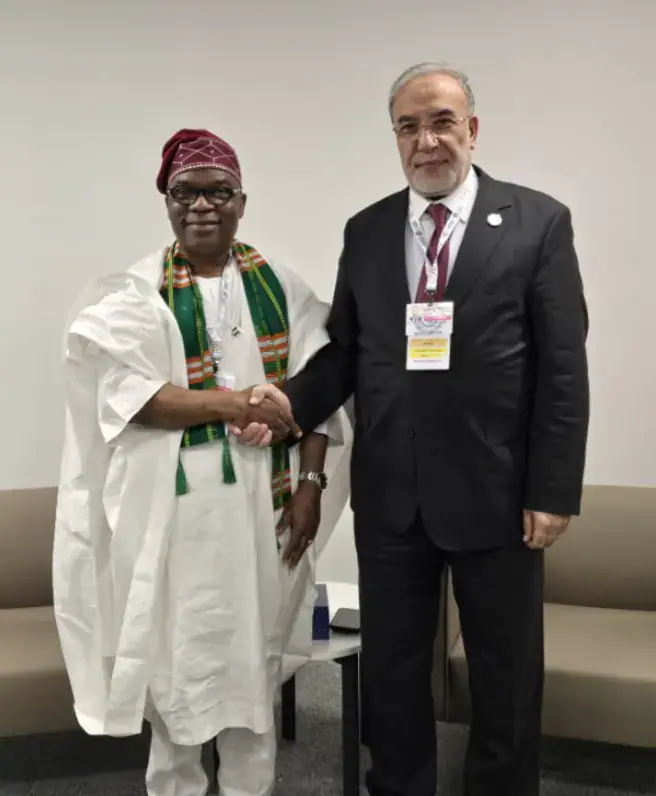
Nigeria has reaffirmed its commitment to a just and equitable energy transition, strengthening its bilateral relations with the United Kingdom and Türkiye at the 31st Conference of the Parties to the United Nations Framework Convention on Climate Change, COP31, in Antalya, Türkiye. The Minister of State for Foreign Affairs, Ambassador Sola Enikanolaiye, reiterated Nigeria's position that the transition from fossil fuels must be orderly, equitable, and sensitive to national circumstances, energy security, and development priorities.
Ambassador Enikanolaiye represented the Minister of Environment at the announcement of the UK-Nigeria Energy Security and Transition Partnership, where he stated that Nigeria remained committed to achieving net-zero emissions by 2060, with natural gas serving as a transition fuel. He identified methane reduction as an immediate priority and reaffirmed the country's commitment to ending routine gas flaring by 2030. A Joint Decarbonisation Working Group was established to drive the implementation of the partnership, and a non-binding Memorandum of Understanding was signed with the United Kingdom.
At the Antalya Leaders' Summit, Turkish President Recep Tayyip Erdoğan called for stronger international support for developing countries confronting the effects of climate change. He described environmental protection as a shared moral responsibility and highlighted Türkiye's Climate Law and water efficiency initiatives as measures to strengthen climate resilience. This call to action underscores the need for global cooperation to address the pressing issue of climate change.
Nigeria and Türkiye have agreed to convene a Joint Economic Commission in the first quarter of 2027 to deepen trade, investment, and bilateral cooperation. The agreement was reached after discussions between Ambassador Enikanolaiye and Türkiye's Deputy Minister of Foreign Affairs for Africa, Ambassador Musa Kulaklikaya. Both countries have identified defence, energy, infrastructure, and trade as priority areas for expanded collaboration.
During the discussions, Nigeria invited Turkish investors to explore opportunities in major gas infrastructure projects, including the Trans-Saharan Gas Pipeline and the Nigeria-Morocco Gas Pipeline. On security cooperation, Nigeria acknowledged Türkiye's support in training its special forces, while both countries agreed to advance a proposed Memorandum of Understanding on defence industry cooperation.
The discussions also addressed regional security and stability in West Africa, particularly the Sahel, ECOWAS, and relations with the Alliance of Sahel States. Both countries further agreed to strengthen consular cooperation and streamline visa arrangements for holders of diplomatic and official passports. This cooperation aims to enhance the existing relations between Nigeria and Türkiye.
Ambassador Enikanolaiye commended Nigerian ingenuity following the presentation of a locally developed solar-powered backpack at an event organised by Innovative Renewable Energy Storage Solution, iRESS. He praised the Nigerian entrepreneur behind the innovation and acknowledged government efforts to tackle the country's energy challenges through ongoing reforms and improved macroeconomic stability. Nigeria's participation at COP31 underscores its commitment to climate diplomacy, sustainable energy development, international cooperation, and indigenous innovation.
Key points
- Nigeria reaffirms commitment to achieving net-zero emissions by 2060.
- Nigeria and Türkiye agree to convene a Joint Economic Commission in 2027.
- Nigeria commends local innovation in renewable energy solutions.