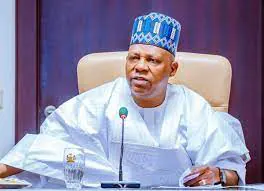
Nigeria's Vice President Kashim Shettima has announced plans to fast-track the National Food and Nutrition Bill to ensure protection of nutrition financing and strengthen accountability across successive administrations. The proposed legislation aims to strengthen the federal government's Nutrition 774 Initiative, which brings together all tiers of government to tackle malnutrition. This move is part of efforts to sustain interventions and provide a unified response to malnutrition, beginning at the community level.
The Nigeria-Ethiopia Nutrition Leadership Exchange Forum in Addis Ababa, Ethiopia, provided the platform for Shettima to disclose that Nigeria's National Policy on Food and Nutrition 2026–2035 has set ambitious targets to reduce the country's stunting rate. The targets include reducing stunting to 32 per cent by 2029, 28 per cent by 2032, and 25 per cent by 2035. Achieving these targets will require a concerted effort from all levels of government and stakeholders.
Shettima noted that with nutrition committees already established in 32 State Houses of Assembly, the time is ripe to give the country's nutrition response stronger legislative backing. Furthermore, nutrition committees have been established in more than 450 local governments, while the federal government is strengthening state councils and delivery capacity across all levels of government. This demonstrates the government's commitment to addressing malnutrition.
The Vice President explained that the Nutrition 774 Initiative provides a single framework that brings together all tiers of government, with governors and local government chairpersons expected to lead implementation within their respective jurisdictions. Each council, being the lowest tier of the system, serves as the unit of planning, financing, and accountability. The government is working with states on costed plans for priority councils.
Shettima disclosed that Nigeria's $26 million commitment to the Child Nutrition Fund has attracted matching support, unlocking $52 million. Additionally, 21 states have contributed $6.3 million since 2023 for supplies aimed at preventing and treating malnutrition. The proposed Presidential Nutrition Investment Fund will provide catalytic financing, while the Nutrition Financing Subcommittee is working to mobilize additional domestic resources.
The Vice President emphasized that the government is strengthening systems linking public expenditure to measurable nutrition outcomes through scorecards and stronger domestic financing. He stated that the urgency of the reforms is underscored by the fact that 40 per cent of Nigerian children under five are affected by stunting, alongside an estimated annual economic loss. Effective implementation of the nutrition initiatives is crucial.
The collaboration between Nigeria and Ethiopia in areas such as security, aviation, trade, investment, and food security is expected to yield positive results. The Nigeria-Ethiopia Nutrition Leadership Exchange Forum serves as a platform for both countries to share best practices and experiences in addressing malnutrition. Nigeria's commitment to addressing malnutrition is evident in its policies and initiatives.
Key points
- Nigeria aims to reduce stunting rates to 25 per cent by 2035.
- The country's $26m nutrition commitment has unlocked $52m in matching funds.
- 40 per cent of Nigerian children under five are affected by stunting.