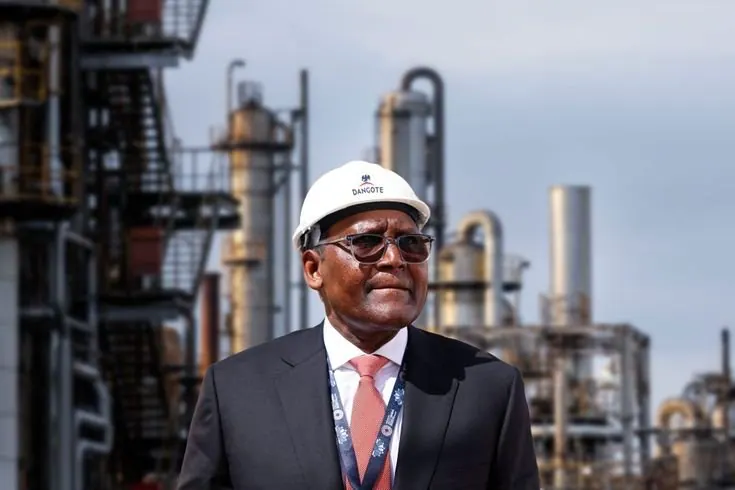
Nigeria's Minister of Finance, Taiwo Oyedele, has stated that the country is currently unable to meet the Dangote refinery's full requirement of 700,000 barrels of crude oil per day. Oyedele made this statement during an appearance on Channels Television's 'Politics Today' programme on Friday. According to him, Nigeria does not have enough crude oil to service the Dangote refinery at its full capacity.
Oyedele further explained that even if Nigeria had 700,000 barrels of crude oil available, it would not be the optimal input for the Dangote refinery. The minister noted that the Nigerian crude oil is considered "sweet crude," but the Dangote refinery still needs to import some heavy crude oil to operate efficiently. This, he said, is a technical aspect of the refinery's operations that some critics do not understand.
The minister attributed Nigeria's inability to meet the Dangote refinery's demands to the country's current crude oil production levels. Oyedele stated that Nigeria does not have up to 700,000 free crude oil barrels to give to anyone, including Dangote. He, however, expressed hope that as Nigeria ramps up production and frees up some barrels, it will be able to meet the Dangote refinery's demands and supply other refiners.
To address the issue, President Bola Tinubu introduced the naira-for-crude deal, which Oyedele said was meant to help Nigeria gain some stability. The minister noted that the deal has worked, but Nigeria still does not have enough quantity to give to the Dangote refinery. Oyedele expressed optimism that Nigeria will eventually refine all the crude oil it produces locally and export only refined products.
Oyedele also explained the forward sale arrangements for crude oil, stating that if Nigeria produces 1.8 million barrels per day, it does not all belong to the country. Under production-sharing contracts and joint ventures, crude oil is allocated among the parties at varying ratios, roughly 45:55. A portion of the crude is used to cover production costs, known as cost oil, while another portion is allocated to royalties before the remaining profit oil is shared.
The minister revealed that Nigeria had almost entirely exhausted its share of crude oil due to petrol subsidy. Before Tinubu introduced the reforms, the Nigerian National Petroleum Company (NNPC) Limited, which holds the country's crude on its behalf, had less than 100,000 barrels of free crude remaining. Oyedele said the government resorted to printing money after exhausting its revenues, but the funds were insufficient to meet its needs.
The government's inability to manage its crude oil resources led to a situation where it began using future crude oil production to secure borrowing for subsidising current consumption. Oyedele described this arrangement as a potential crisis waiting to happen. The minister's statements highlight the challenges Nigeria faces in managing its crude oil resources and meeting the demands of the Dangote refinery.
Key points
- Nigeria's crude oil production is insufficient to meet the Dangote refinery's demand of 700,000 barrels per day.
- The country is working to ramp up production and stabilize its crude oil supply.
- Nigeria aims to refine all its crude oil locally and export only refined products in the future.