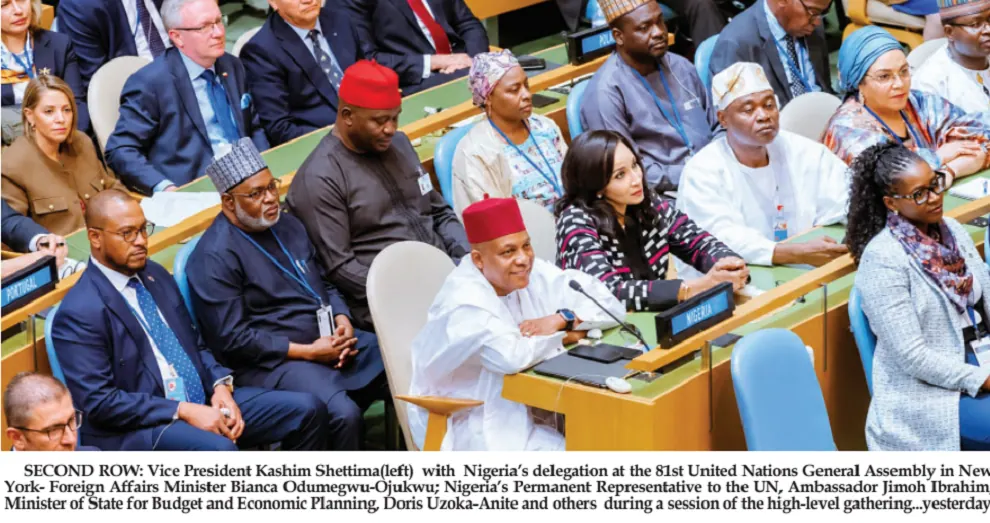
Nigeria took centre stage at the 81st Session of the United Nations General Assembly (UNGA 81) in New York, spearheading a continental push to end raw mineral exports, advocating for global governance reforms, and driving sub-national economic partnerships. Vice President Kashim Shettima led the national delegation on behalf of President Bola Ahmed Tinubu, engaging in high-level discussions to shift Africa from an extraction-based economy to an integrated industrial powerhouse.
The Nigerian delegation’s agenda spans critical mineral security, safety reforms for artisanal miners, investment drives by state executives, and a renewed diplomatic campaign for permanent African representation on the UN Security Council. President Tinubu warned that Africa could no longer allow its deposits of cobalt, copper, lithium, and rare earth elements to enrich foreign nations while host communities remain in poverty.
Tinubu highlighted Nigeria’s mining reforms, which increased government revenue from N6 billion in 2023 to nearly N70 billion by 2025, alongside major private investments in local lithium processing. He urged member states to enforce local processing, refining, and value addition before export, citing that fragmentation leaves Africa exporting raw materials and buying finished goods at a premium.
African leaders adopted and signed the Continental Integration and Economic Assurance Declaration (CIEAD), a milestone framework designed to align critical mineral policies, secure supply chains, and build cross-border infrastructure corridors. Nigeria’s Minister of Solid Minerals Development and AMSG Chairman, Dr. Dele Alake, advocated for the creation of a Mine Emergency and Community Recovery Fund to provide geological guidance, basic safety equipment, and emergency response capabilities to protect vulnerable mining communities.
The Africa Finance Corporation (AFC) CEO Samaila Zubairu stressed that unified regional action is essential to industrialise the continent rapidly enough to meet the needs of its surging population over the next two decades. Nigeria reaffirmed its core foreign policy objectives for UNGA 81, including a renewed push for a permanent seat for Africa on the 15-member UN Security Council to correct historical imbalances in global decision-making.
Rivers State Governor Sir Siminalayi Fubara engaged global investors to attract capital to the state’s energy sector, highlighting Rivers State’s strategic position in Nigeria’s oil and gas landscape and seeking fresh financing partnerships. Fubara noted that these diplomatic engagements align directly with the mandate of the newly established Rivers State Investment Promotion Agency.
In response to public commentary regarding President Tinubu delegating UNGA leadership to Vice President Shettima for a third consecutive year, APC chieftain and security expert Abayomi Mumuni defended the President’s choice, emphasising that UNGA is a diplomatic platform where representation by designated state officials is fully recognised under the UN Charter.
Key points
- Nigeria pushes for an end to raw mineral exports and global governance reforms at the 81st UNGA.
- African leaders adopt the Continental Integration and Economic Assurance Declaration to align critical mineral policies.
- Nigeria reaffirms its push for a permanent seat for Africa on the UN Security Council.