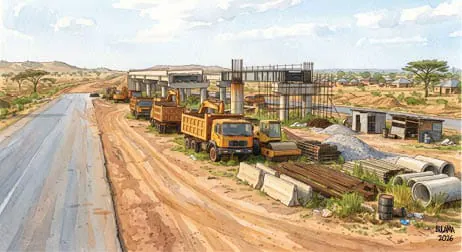
Road networks across Nigeria serve as vital arteries that facilitate the movement of goods and people, but the state of the roads is increasingly deteriorating, wasting man-hours and causing frustration to commuters. The Federal Ministry of Works has reported that the federal government is working on an estimated 5,400 kilometres of highways and strategic road corridors across the country. However, the progress has been slow, and many of these projects have stalled or been abandoned.
The Minister of Works, Senator David Umahi, has stated that the government is not considering dumping projects it inherited, but projects that would be considered for funding would have to have reached 80 per cent completion. He also emphasized the need for alternative sources of funding outside the government's coffers, as funding them through annual budgets alone has become impossible. This statement highlights the challenges faced by the government in completing these projects.
One of the notable projects that have suffered from years of delays and abandonment is the 46km Ring Road project in Kano State. The project, designed to connect Naibawa flyover through Dorayi underpass, crossing Gwarzo Road and terminating at Dawanau International Grains Market, was first conceived during the Governor Rabiu Kwankwaso administration (2011–2015). Although revival efforts under Governor Abba Kabir Yusuf in 2024–2025 have delivered partial progress, the road remains incomplete.
Another project that has faced significant challenges is the 30km Northern Bypass, initiated over a decade ago. The project was intended to provide an alternative route for long-haul traffic, but federal takeover in 2025 rekindled hopes, and in 2026, construction is still dragging, leaving commuters to battle gridlock in Kano metropolis. The 550km Kano–Maiduguri highway, one of Nigeria's most strategic corridors, has also suffered from funding delays, contractor disputes, and insecurity in Yobe and Borno.
The Kano–Maiduguri highway, popularly known as the North-East Highway, spans Kano State through Jigawa, Bauchi, and Yobe states, terminating in Borno State (Maiduguri). Although major sections were completed and inaugurated during the Muhammadu Buhari administration in 2021, some sections remain unfinished, with big potholes and worn-out sections that are barely fit for use. The project has been divided into five primary sections, with Section V, the dualisation project, initially budgeted at N39.9 billion, with a completion deadline of December 2009.
Motorists, commercial drivers, and business owners plying the Maiduguri-Damaturu section of the northwestern highway have raised the alarm over the deplorable state of the uncompleted expressway. They describe it as a daily nightmare that threatens lives, security, and economic livelihoods. According to Salisu Yunusa, a commercial driver, roughly 50 per cent of the specific section remains unfinished, and what should ordinarily be a swift one-hour journey now stretches to between two and three hours due to the poor condition of the road.
The deplorable state of the roads has also raised security concerns, with private car owners and commuters grappling with severe security risks. Mohammed Abubakar, a private vehicle owner, pointed out that the snail's pace forced upon motorists by the bad road provides an advantage to Boko Haram terrorists, who exploit the traffic situation to launch deadly attacks and kidnappings. The situation calls for urgent attention from the government and stakeholders to address the challenges facing Nigeria's infrastructure development.
Key points
- The Nigerian government is working on an estimated 5,400 kilometres of highways and strategic road corridors across the country.
- Many of Nigeria's roads have remained in a deplorable state despite years of budgetary allocations and repeated promises of rehabilitation and reconstruction.
- The deplorable state of the roads has significant economic and security implications for the country.