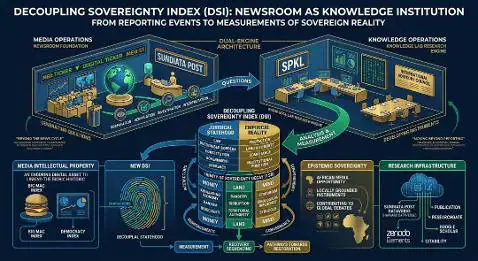
The Sundiata Post Knowledge Lab has developed the Decoupling Sovereignty Index, an instrument to measure the conditions of sovereignty. This development is rooted in a tradition where media organisations and research institutions create indices to measure complex realities. The Decoupling Sovereignty Index is part of this intellectual lineage, challenging conventional notions of a media organisation's role. It joins a distinguished tradition of media organisations developing analytical tools to assess economic, political, and social realities.
A notable example of this tradition is The Economist's Big Mac Index, introduced in 1986. Initially a light-hearted way to explain purchasing power parity, it became a widely recognised reference point for comparing currencies. The index used the price of a Big Mac across different countries to illustrate differences in purchasing power and currency valuation. This demonstrates that a publication can create a measurement tool, sustain it, and contribute to public understanding of complex issues.
The Economist has also developed the Glass-Ceiling Index, which assesses women's position and influence in the workforce across OECD countries. This index examines dimensions such as education, labour-force participation, pay, and representation. It shows how a media organisation can use data to make complex social conditions more visible. Another example is the Democracy Index, produced by the Economist Intelligence Unit, which assesses countries through indicators covering electoral process, functioning of government, and civil liberties.
Bloomberg's Billionaires Index is another example of a media organisation developing a measurement product. It tracks the estimated net worth of the world's wealthiest individuals using financial information and market movements. This index converts financial developments into a regularly updated instrument that attracts attention beyond business reporting. It illustrates the commercial and institutional possibilities of building a data asset around a subject of public interest.
The News Coverage Index, developed by the Pew Research Center's Project for Excellence in Journalism, represents a journalism-research tradition. It systematically examined news coverage across different media sectors to identify stories, subjects, and newsmakers receiving attention. This index shows that measurement can be directed towards journalism and the information environment itself.
The Decoupling Sovereignty Index takes this tradition into a more complex field, measuring the distance between statehood and sovereign reality. Its development is significant, as it challenges conventional notions of what a media organisation can become. The index is part of a broader tradition where media organisations and research institutions develop structured instruments for understanding and comparing aspects of the world.
The Decoupling Sovereignty Index is an important development in the media landscape, demonstrating the capacity of media institutions to produce analytical instruments that travel beyond the immediate news cycle. Its significance lies in its ability to measure complex realities, providing a new tool for understanding and comparing aspects of sovereignty.
Key points
- The Decoupling Sovereignty Index is part of a tradition where media organisations develop analytical instruments to measure complex realities.
- The index challenges conventional notions of what a media organisation can become.
- The Decoupling Sovereignty Index measures the distance between statehood and sovereign reality.