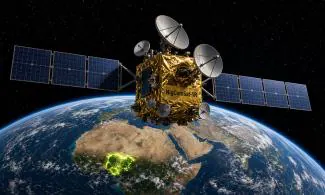
Nigeria's plan to deploy new communications satellites faces a major regulatory hurdle after losing priority for a key orbital position at 9.5° West. The country had pursued this position since 2017 for the NIGCOMSAT-2D satellite network, crucial for its next-generation satellite programme. The International Telecommunication Union (ITU) published the cancellation of the original 2017 NIGCOMSAT-2D filing on March 3, 2026.
Despite the setback, Nigeria submitted a replacement filing for NIGCOMSAT-2D at the same 9.5°W position, received by the ITU on December 3, 2025. This replacement filing must now contend with at least 22 earlier satellite claims, complicating Nigeria's efforts to secure the position. The loss of the 2017 priority means Nigeria's new filing does not automatically carry the same regulatory seniority.
The Nigerian Communications Satellite Limited (NIGCOMSAT) has embarked on a major programme to replace the ageing NigComSat-1R and acquire new satellites. In July 2024, NIGCOMSAT commenced the acquisition of a replacement satellite and began the expression-of-interest process for NIGCOMSAT-2A and 2B. The agency aims to launch NIGCOMSAT-2A and 2B in 2027/2028.
The changing satellite designations have contributed to confusion around the orbital positions. Initially, the 9.5°W position was associated with the NIGCOMSAT-2D filing. However, at another stage, Nigerian submissions referred to NIGCOMSAT-2B at 9.5°W and NIGCOMSAT-2D at 16°W. The distinction between orbital position and satellite network designation is crucial as Nigeria's satellite programme evolves.
A source familiar with the matter likened Nigeria's position to building a very expensive car without knowing where it would be parked. The source described it as "madness" to risk investing $250 million (N332 billion) in a satellite without securing the orbital position. This highlights the uncertainty surrounding the regulatory coordination required before Nigeria can deploy the satellite.
Nigeria had previously sought an emergency intervention costing about $6.9875 million to preserve its position and address the regulatory challenge. However, the cancellation of the original filing means the outcome of that intervention deserves scrutiny. It is unclear whether the entire amount was released and spent.
The number of earlier satellite claims is central to the emerging problem. Nigeria's replacement filing at 9.5°W now faces at least 22 earlier-priority networks, complicating the coordination process. Satellite coordination involves technical aspects such as frequency assignments, power levels, and interference calculations, making the process more complicated with a larger number of earlier networks involved.
Key points
- Nigeria lost the 2017 priority for the 9.5°W satellite position due to the cancellation of its original filing.
- The country faces at least 22 earlier satellite claims for the 9.5°W position.
- Nigeria's satellite programme involves significant investment, with plans to launch NIGCOMSAT-2A and 2B in 2027/2028.