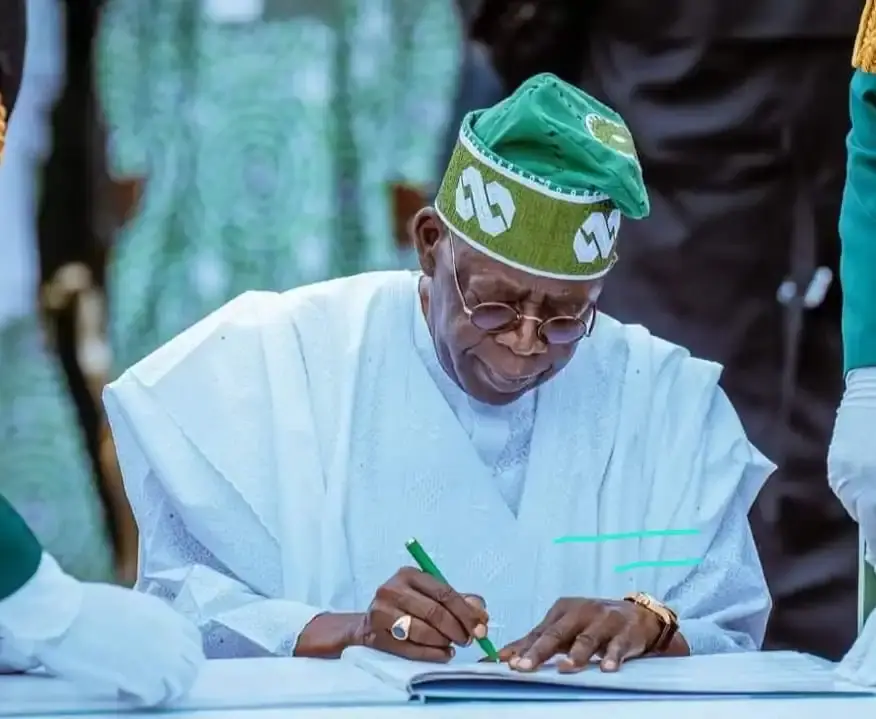
President Bola Tinubu is seeking legislative approval for a proposed $21.7 billion external borrowing package, raising questions about Nigeria's capacity to sustain additional debt. The proposed borrowing aims to finance infrastructure, electricity, transportation, healthcare, education, and other development projects. This move has reopened a national conversation about Nigeria's dependence on loans and its economic future.
Nigeria's total public debt has risen significantly, from N97.34 trillion at the end of 2023 to N144.67 trillion in 2024 and N159.28 trillion at the end of 2025, according to the Debt Management Office. The increase is attributed to exchange-rate movements and the recognition of previously accumulated liabilities. Economists argue that the real issue is whether Nigeria's revenue base can support additional obligations and whether projects will generate sufficient economic returns.
Economists have expressed concerns about the proportion of government revenue committed to debt servicing. Professor Bongo Adi warns that the proposed borrowing could push Nigeria's debt-service-to-revenue ratio beyond 100%, implying that everything the country earns will be used to service debt. This is particularly troubling for a country struggling to finance essential public services like education, healthcare, and security.
The Association of Small Business Owners of Nigeria has also cautioned that Nigeria's weak revenue base makes additional borrowing a serious fiscal concern. Dr. Femi Egbesola argues that borrowing is not necessarily wrong if it generates economic growth and revenue sufficient to justify its cost. He emphasizes that debt-service-to-revenue is a more important indicator than debt-to-GDP, as it shows how much government income goes towards servicing obligations.
Development economist Aliyu Ilias questions the increasing dependence on borrowing despite the removal of petrol subsidy and foreign-exchange reforms. He notes that debt servicing already consumes a substantial portion of government expenditure and warns that additional borrowing could worsen inflationary pressures if not matched by increased production of goods and services.
Economists stress the need for Nigeria to improve revenue generation and reduce its dependence on loans. Muda Yusuf argues that the country must devise strategies to ensure sustainable debt levels and improve tax reforms to increase government revenue. The concerns are particularly relevant given the increase in Federation Account revenue, which rose to N37.44 trillion in 2025 from N17.08 trillion in 2023.
For ordinary Nigerians, the debate is about whether government borrowing translates into better living conditions. Citizens express concerns about the impact of borrowing on their daily lives, from unreliable electricity to high fuel costs and poor living standards. While some see borrowing as necessary for development, others question its effectiveness and worry about the country's ability to repay its obligations.
Key points
- The proposed $21.7 billion loan aims to finance infrastructure and development projects.
- Economists warn that Nigeria's debt-service-to-revenue ratio could exceed 100% with additional borrowing.
- Citizens express concerns about the impact of borrowing on their daily lives and the country's economic future.