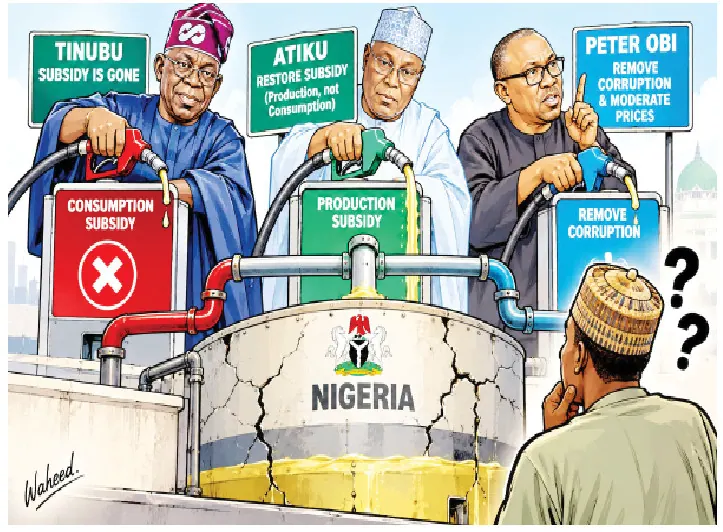
As Nigeria prepares for the 2027 election, its top presidential candidates are weighing in on the contentious issue of fuel subsidy. A common phenomenon in the country's political landscape, especially during election seasons, is the proliferation of policy promises aimed at securing votes. These promises often target what can be termed the "sacred voter," a temporary designation given to citizens during election periods. This voter-centric approach is not unique to Nigeria, but rather a widespread practice.
President Bola Ahmed Tinubu's administration has been at the forefront of the fuel subsidy debate. During his 2023 swearing-in ceremony, Tinubu declared, "Subsidy is gone." This move was seen as a significant step towards reforming the country's fuel subsidy regime. The decision was not taken lightly, as it presented a difficult choice between two challenging options. The country's economic reality in 2023, marked by significant financial constraints, necessitated a tough decision.
Atiku Abubakar, a presidential candidate, has proposed restoring the fuel subsidy regime but with a twist. He suggests redirecting subsidies from consumption to production. While this proposal appears sound in theory, its feasibility is uncertain. A critical concern is the funding aspect, as the country's financial situation has led to significant borrowing. Atiku's plan echoes a familiar narrative, one that requires careful consideration of the country's financial realities.
The fuel subsidy regime has been a contentious issue in Nigeria, with various stakeholders presenting differing views. The country's previous subsidy regime was criticized for inefficiencies and corruption. The current administration's decision to remove the subsidy has sparked intense debate, with some arguing that it was a necessary step towards reform. Others have expressed concerns about the impact on citizens.
Peter Obi, another presidential candidate, has presented a somewhat ambiguous stance on fuel subsidy. During the Nigerian Bar Association conference in Port Harcourt, Rivers State, Obi rejected Atiku's proposal to reinstate the subsidy. He argued that mismanagement of proceeds should not be a reason for not removing the subsidy. However, in a subsequent interview on Arise TV, Obi shifted his position, suggesting that moderating fuel prices by removing corruption from the system was a more effective approach.
Obi's proposal to moderate fuel prices by addressing corruption in the system has sparked interest among stakeholders. His suggestion that petrol and other prices would decrease if corruption were removed from the subsidy regime has raised questions about the feasibility of such a plan. The country's fuel subsidy regime has been plagued by corruption and inefficiencies, making Obi's proposal an important consideration.
The debate surrounding fuel subsidy in Nigeria highlights the complexities of policy-making in the country. The various proposals presented by presidential candidates underscore the need for a comprehensive approach to addressing the country's challenges. As the 2027 election approaches, citizens will be closely watching the candidates' policy promises and their potential impact on the country.
Key points
- Presidential candidates in Nigeria are presenting different proposals on fuel subsidy ahead of the 2027 election.
- The country's fuel subsidy regime has been marked by inefficiencies and corruption.
- The candidates' proposals have sparked intense debate among stakeholders.