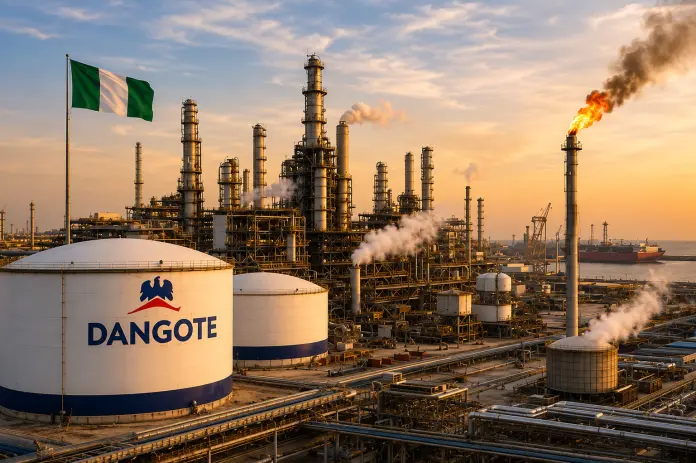
Nigeria's petroleum market is undergoing a significant transformation, with the country simultaneously earning hundreds of billions of naira from petrol exports and spending almost as much importing the same product. According to a report by SBM Intelligence, Nigeria earned N998.5 billion from petrol exports in the first half of 2026, more than six times the value recorded a year earlier. This increase is largely attributed to rising output from the Dangote Petroleum Refinery, which has created growing volumes for both the domestic market and export destinations.
Despite the growth in petrol exports, Nigeria's dependence on imports has not ended. Data from the National Bureau of Statistics showed that the country spent N952.15 billion importing petrol in Q2 2026 alone, compared with just N87.40 billion in Q1. This quarterly increase of almost 11-fold highlights the complexities of Nigeria's fuel market transition. The result is an extraordinary contradiction: Nigeria exported N546.02 billion worth of petrol in Q2, while importing N952.15 billion worth of the same commodity.
The emergence of Nigeria as a petrol exporter has been driven by the increasing output of the Dangote Refinery, which has enabled the country to move from being overwhelmingly dependent on imported petrol to becoming a significant exporter to regional and international markets. In the first half of 2026, petrol exports reached N998.5 billion, with African markets accounting for more than 60 percent, or about N621.72 billion, of the total. This development represents a striking reversal from the position only a few years ago, when Nigeria routinely spent trillions of naira importing petrol because domestic refineries were unable to meet national demand.
However, the import figures show that the transition is far from complete. NBS data showed that petrol imports accounted for 6.6 percent of Nigeria's total imports of N14.42 trillion in Q2, making PMS the country's largest imported commodity during the quarter. Despite the massive quarterly rebound, the Q2 import bill remained significantly below the level recorded in Q2 2025, pointing to a market in transition rather than a return to the previous scale of import dependence.
The volume picture is equally revealing, with average petrol imports declining quarter-on-quarter from 11.23 million litres per day in Q1 to 9.23 million litres per day in Q2, even as the naira value of imports surged. This divergence suggests that movements in international prices, exchange rates, and the composition of supplies played an important role in the sharp increase in import expenditure. Meanwhile, domestic refining has continued to expand, with locally refined petrol supply rising strongly in early 2026.
A court ruling on September 28 ordered the Nigerian Midstream and Downstream Petroleum Regulatory Authority to continue granting and renewing petroleum-products import licences to Matrix Energy, AA Rano, and AYM Shafa, provided the companies satisfy the relevant statutory and regulatory requirements. The ruling is significant because it comes amid an increasingly visible contest over the future structure of Nigeria's petrol market, with competing positions on how to encourage massive investment in domestic refining without closing the market to competition and alternative sources of supply.
The issue extends beyond petrol to gas and crude supply, with NMDPRA targeting September 24, 2028, for the transition away from regulated domestic gas pricing towards a willing-buyer, willing-seller framework. The Nigerian Upstream Petroleum Regulatory Commission reported that producers offered 182 million barrels of crude oil to domestic refiners between January and August 2026, exceeding the refiners' stated requirement of 154.6 million barrels. However, only 112 million barrels were actually transacted, leaving a gap of about 70 million barrels between crude offered and crude ultimately supplied.
Key points
- Nigeria's petrol export earnings reached N998.5 billion in H1 2026, driven by rising output from the Dangote Petroleum Refinery.
- The country spent N952.15 billion importing petrol in Q2 2026, highlighting a complex transition in the fuel market.
- A court ruling has ordered the NMDPRA to continue granting import licences to certain companies, amid a contest over the future structure of Nigeria's petrol market.