Nigeria's creative sector, valued at N4.57 trillion in 2025, is struggling to attract investment due to weak financial records and intellectual property risks. Filmmaker Tosin Adesegun says investors want to assess the technical quality and professionalism of previous work, as well as legal and regulatory compliance. This includes evidence of tax payments and clear IP documentation to protect projects against litigation. Investors are assessing a business, not just a creative concept.
The trust deficit between filmmakers and financial institutions is deepening, making it harder for the industry to attract capital. Folajimi Alli-Balogun of MBO Capital says both sides must address the problem. Investors consider a filmmaker's track record, production budgets, and distribution plans, but many creatives struggle to demonstrate how investments will generate returns. This gap becomes evident when filmmakers are asked to provide financial projections, audited accounts, and distribution agreements.
Ann Marème Atayi of Bpifrance says the problem runs in both directions, with investors not understanding how creative businesses generate revenue, and creatives not knowing what financiers expect. She had to approach industry professionals to understand their business models before assessing their financing needs. Investors must understand the economics of creative businesses rather than applying conventional financing expectations.
A Nollywood film's commercial performance depends on factors like audience reception and marketing expenditure, making precise financial projections challenging. However, uncertainty does not eliminate the need for financial planning. Producers seeking investment must demonstrate how production budgets were calculated, how much funding has been secured, and how revenue will be shared among stakeholders.
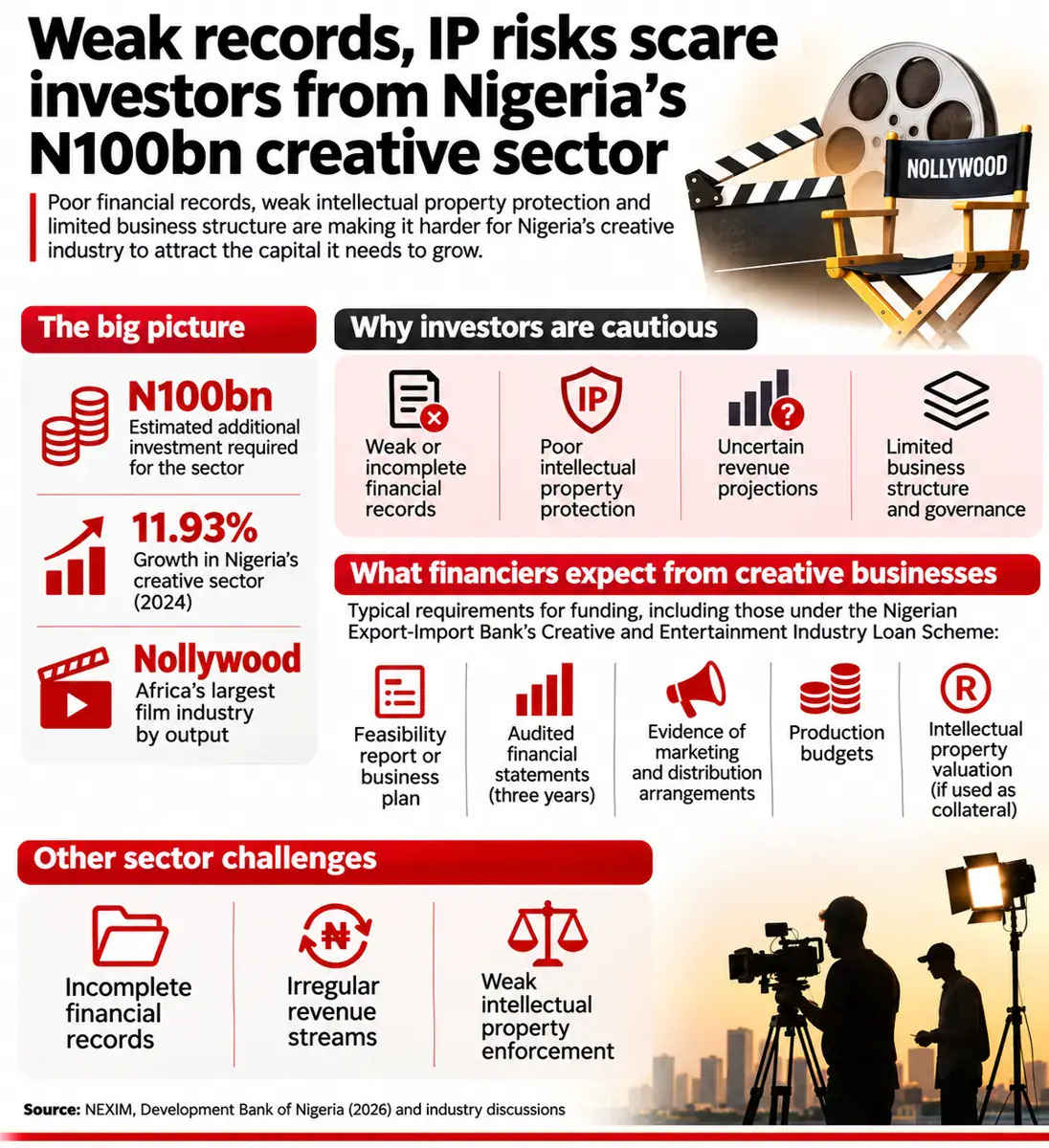
Nigeria's existing financing requirements illustrate what financial institutions expect. The Nigerian Export-Import Bank's loan scheme requires applicants to provide a feasibility report, audited financial statements, and evidence of marketing and distribution arrangements. These requirements show that accessing finance involves more than presenting a compelling creative idea.
Many Nigerian creative businesses lack the financial records and formal structures required by traditional lenders. A research note by the Development Bank of Nigeria identified incomplete records, irregular revenue streams, and weak IP enforcement as factors increasing lenders' uncertainty. The research also showed that the sector expanded by 11.93 percent year-on-year in the second quarter of 2026.
The creative sector needs an additional N100 billion in baseline investment to scale effectively and unlock economic value. The size of the market has not automatically translated into accessible financing. Industry experts say producers must demonstrate a credible business plan, including distribution agreements and pre-sales, to establish potential revenue streams and secure investment.
Key points
- The Nigerian creative sector requires clear financial records and IP documentation to attract investment.
- Investors need to understand the economics of creative businesses to make informed decisions.
- The sector needs an additional N100 billion in baseline investment to scale effectively.