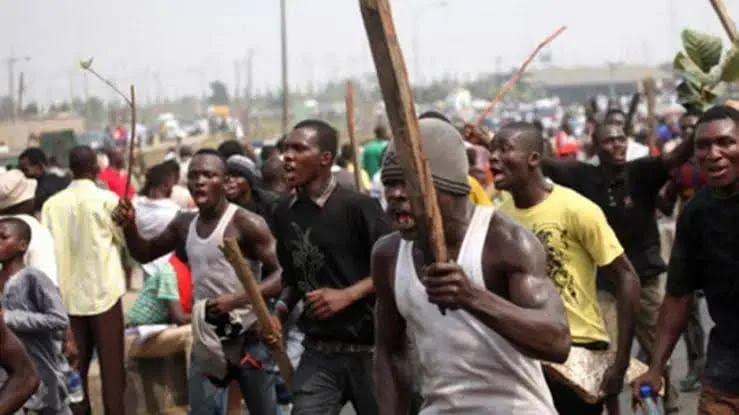
In Nigeria, accusations of theft or crime can rapidly escalate into violent mob attacks, often resulting in serious injuries or fatalities. The practice of jungle justice, or mob violence, has persisted despite the existence of courts, police, and other institutions established to investigate crimes and administer justice. This phenomenon has raised concerns about public safety, trust in law enforcement, and the rule of law.
The issue of mob justice gained national attention with the killing of the "Aluu Four" in 2012. Four students of the University of Port Harcourt were attacked and killed by a mob in Aluu community, Rivers, after being accused of stealing. The incident sparked widespread outrage and calls for an end to mob justice. However, similar incidents have continued to occur, including the killing of 16 travellers in Uromi, Edo, in March 2025, and the death of 25-year-old Ibrahim Mbaya in Jos, Plateau, in July.
The Inspector-General of Police, Mr Olatunji Disu, has directed that jungle justice be treated as homicide, a move supported by security advocacy groups. The President of the Security Situation Room, Mr Douglas Ogbankwa, described mob action as an invitation to anarchy and emphasized the need for perpetrators to be held accountable. He argued that allowing individuals to take the law into their hands would undermine the purpose of government and the rule of law.
Security analysts and legal practitioners have also weighed in on the issue. Ahmed Umar, a security analyst, stressed that responses to suspected crime should begin with reporting and investigation, rather than punishment by a crowd. Yusuf Aliyu Yusuf, a legal practitioner, noted that an accusation is not the same as proof of guilt and that the responsibility of determining guilt lies with institutions established by law.
Community leaders have also emphasized the role of communities in preventing mob attacks. Barau Kawu, a community leader, advised community members to avoid taking action based solely on allegations or information received from others and to report suspected criminal activities to security agencies. He stressed that communities have a crucial role to play in promoting peaceful resolution of conflicts.
Obtaining accurate national figures for deaths resulting from jungle justice is challenging, as many incidents may not be reported to the police, courts, or mainstream media. Analysts cite public distrust of law enforcement institutions and the country's worsening insecurity as major factors behind the practice. The increasing suspicion of strangers and unfamiliar situations has contributed to the rapid spread of suspicion and violent mob attacks.
The Nigerian government and institutions have a critical role to play in addressing the issue of mob justice. Section 33 of the 1999 Constitution protects the right to life, subject to exceptions stated in the Constitution. The law provides for allegations to be investigated and suspects to be tried in court, a process that cannot be replaced by a crowd. Ultimately, promoting trust in law enforcement, addressing insecurity, and encouraging community participation are crucial to preventing mob justice and protecting human rights.
Key points
- The practice of mob justice in Nigeria has resulted in numerous deaths and injuries, despite existing laws and institutions.
- The Inspector-General of Police has directed that jungle justice be treated as homicide, a move supported by security advocacy groups.
- Analysts cite public distrust of law enforcement institutions and the country's worsening insecurity as major factors behind the practice of mob justice.