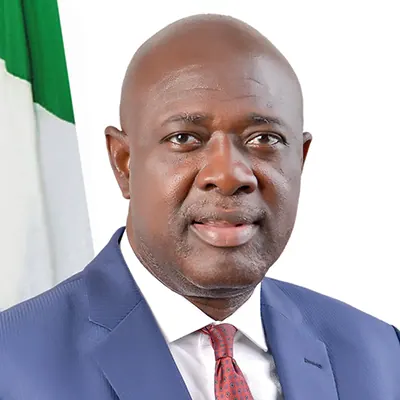
Nigeria's indigenous oil and gas companies now account for about 60 per cent of the country's crude production, Minister of State for Petroleum Resources (Oil), Heineken Lokpobiri, has disclosed. This significant growth in indigenous participation has led to a substantial increase in the retention of value within Nigeria. Lokpobiri made this revelation when he received the Minister of Petroleum of the Republic of Congo, Stev Simplice Onanga, and his delegation in Abuja.
The growth of indigenous participation in Nigeria's oil and gas industry is attributed to deliberate local content policies and the divestment of some international oil companies' onshore and shallow-water assets to Nigerian operators. Lokpobiri noted that before now, international oil companies (IOCs) dominated the industry, but the current situation reflects a significant shift. He cited Renaissance as an example of a company that is fully managed by Nigerians and operates without expatriate staff.
The development has also led to the emergence of a growing number of competent Nigerian oilfield service companies capable of competing alongside international operators. Lokpobiri mentioned that there are over 20 to 30 competent Nigerian companies in the service industry today. This is a significant improvement from the past when international service companies like Schlumberger were dominant.
According to Lokpobiri, while international service companies continue to play a major role in deep offshore operations, Nigerian companies have increasingly taken responsibility for land, swamp and shallow-water operations. This shift has contributed to the growth of indigenous participation and the retention of value within Nigeria.
The Nigerian Content Development and Monitoring Board (NCDMB) has played a significant role in building the capacity of indigenous companies and professionals in the sector. Lokpobiri explained that NCDMB's operations are financed by contributions from the oil and gas industry rather than direct government funding. This policy has helped Nigeria develop indigenous manpower, service companies and operators.
Lokpobiri emphasized that the solution to Africa's energy poverty problems lies with Africans themselves. He stressed that Africans must take their own destiny in their own hands and develop their own solutions. This, he believes, is what Nigeria is doing through its local content policy.
The visit by the Congolese delegation aims to study Nigeria's local content policy and implementation to draw lessons that can be applied in the Republic of Congo. The delegation comprises officials responsible for upstream petroleum, local content, downstream and gas, as well as representatives of Congo's national oil company and indigenous companies.
Key points
- Nigeria's indigenous oil companies now produce 60% of the country's crude.
- The growth of indigenous participation has led to a significant increase in the retention of value within Nigeria.
- The Nigerian Content Development and Monitoring Board has played a significant role in building the capacity of indigenous companies and professionals in the sector.