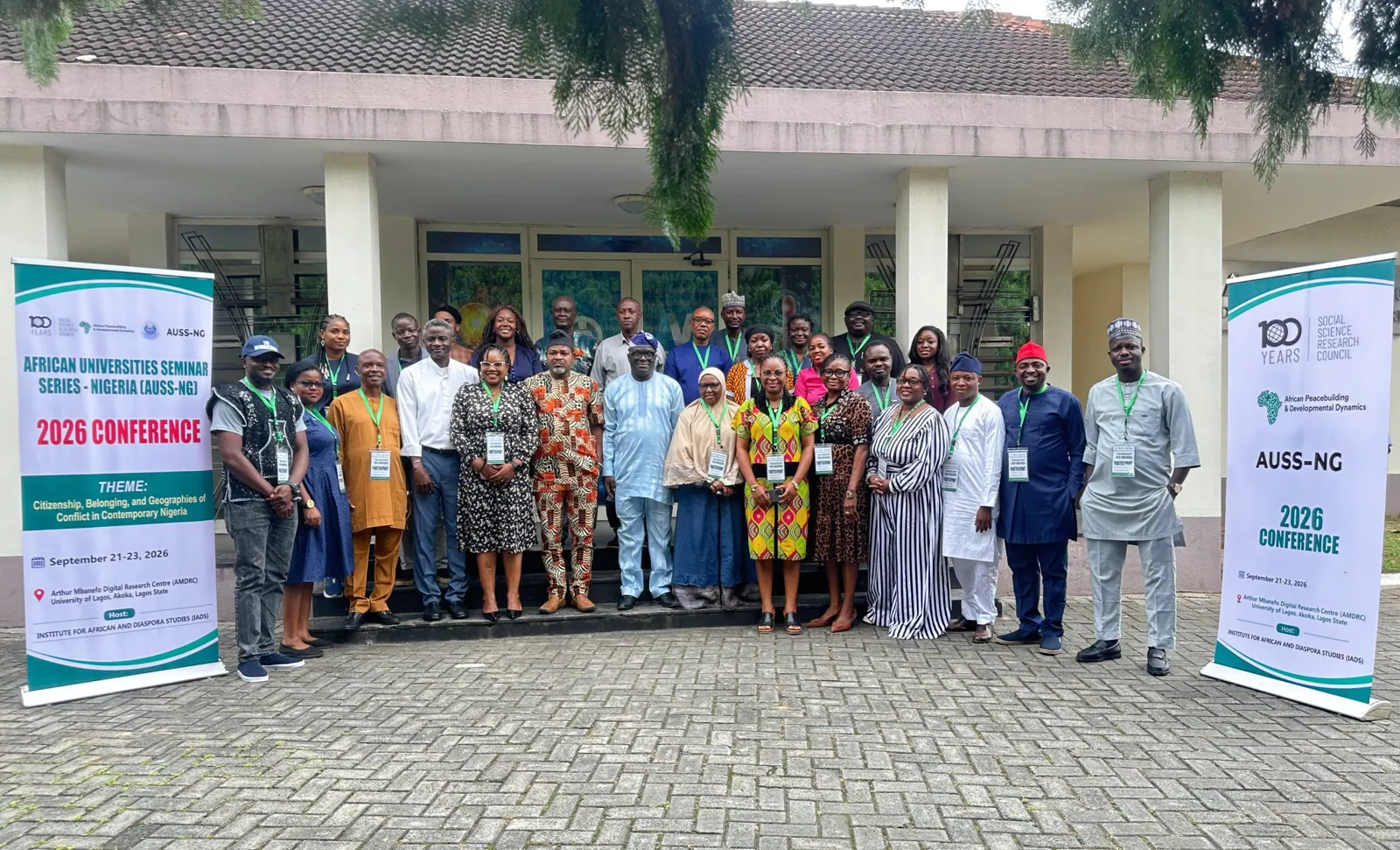
A holistic and interdisciplinary approach is necessary to tackle Nigeria's insecurity, considering its multifaceted dimensions. This was the assertion of Professor Afe Adogame, a renowned expert in Religion and Society at Princeton Theological Seminary, New Jersey, United States. He made this call at the 2026 conference of the African Universities Seminar Series Nigeria (AUSS-NG), hosted by the Institute for African and Diaspora Studies (IADS) at the University of Lagos.
Adogame emphasized that Nigeria's security challenges are shaped by interconnected factors that require in-depth investigation. He stressed the need for researchers to transcend disciplinary boundaries and examine insecurity from multiple perspectives. According to him, no single theory or approach can adequately explain the variety of conflicts and violence in the country. This underscores the importance of a comprehensive approach to address the complex security landscape.
The professor identified kidnapping as a prime example of the complexity of Nigeria's insecurity, citing the need for research into both remote and immediate causes, as well as endogenous and exogenous factors contributing to its persistence. He suggested that examining the historical evolution of kidnapping and related practices would provide valuable insights into the contemporary security crisis. This, he believes, would help in developing effective strategies to combat the menace.
Adogame also highlighted the significance of context in understanding conflicts, noting that the same incident could have different meanings in different environments. He urged scholars to examine specific cases before making broader theoretical conclusions about conflict and violence. Additionally, he challenged conventional perceptions of security, arguing that some measures presented as evidence of security could, in fact, expose the depth of insecurity in society.
The professor described the phenomenon of securitisation of insecurity and the insecuritisation of security, emphasizing the need for society to rethink its understanding of both concepts. He cited the heavy security arrangements often deployed around political leaders as an example, noting that such measures did not necessarily guarantee their safety. Instead, they could be indicative of deeper insecurity.
Adogame argued that genuine security should provide the conditions under which citizens can live without fear. He questioned the widespread deployment of security personnel, suggesting that it should prompt an examination of the underlying conditions that make such protection necessary. According to him, the use of armoured vehicles, heavily protected residences, and large numbers of security personnel by political leaders does not necessarily translate to security.
The conference, themed 'Citizenship, Belonging and Geographies of Conflict in Contemporary Nigeria,' provided a platform for experts to discuss the complexities of Nigeria's security challenges. Adogame's keynote address, titled 'Holy Violence, Unholy Embrace: The Intersection of Religious Conflict and Insecurity,' set the tone for the discussions. The event was hosted by the Institute for African and Diaspora Studies (IADS) at the University of Lagos.
Key points
- Professor Afe Adogame calls for interdisciplinary approach to address Nigeria's complex security challenges
- Nigeria's security challenges are shaped by interconnected factors that require in-depth investigation
- Genuine security should provide the conditions under which citizens can live without fear