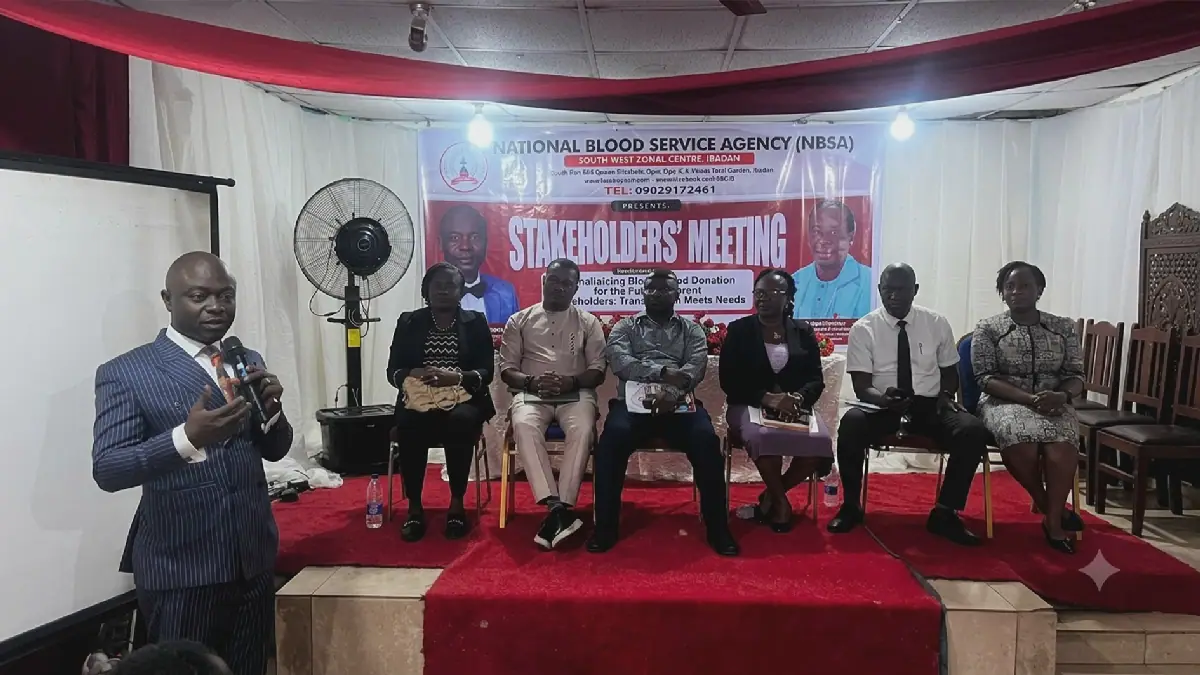
The National Blood Service Agency (NBSA) has identified inadequate voluntary donations as a major obstacle to achieving sufficient national blood reserves in Nigeria. According to the agency, the country generates between 24,000 and 25,000 units of blood annually, significantly below the national demand of approximately 1.8 million to two million units. This creates a substantial gap between supply and need, leaving hospitals exposed in emergencies.
The Director-General of NBSA, Prof Sale Yuguda, disclosed this at a media roundtable on voluntary blood donation and the formal inauguration of the Media Cell for Safe Blood in Abuja. He stated that Nigeria needs at least two per cent of its population to participate in blood donation to bridge the supply gap, improve access to safe blood, and reduce the pressure on patients' relatives, who are often compelled to source donors during medical emergencies.
Yuguda noted that the NBSA is strengthening its regulatory and monitoring framework to improve the safety, quality, and traceability of blood collected and distributed across the country. The agency is introducing a National Blood Management System, a digital platform to monitor the collection, processing, distribution, and use of donated blood. This electronic system will enable the agency to trace every unit of blood from the donor to the recipient and identify the source of any complications arising from transfusion.
The NBSA is also strengthening the registration and regulation of public and private blood banks, stressing that hospitals and blood transfusion establishments must register with the NBSA to ensure compliance with approved standards. Yuguda stated that the agency is expanding its hospital linkage programme to improve blood distribution and prevent improper transportation and storage. Under this arrangement, registered health facilities will communicate their blood requirements to the agency to enable it to forecast demand and organise distribution more effectively.
Yuguda called for government intervention to make blood available free of charge, stressing that removing financial barriers would improve access for patients requiring transfusion and encourage a stronger culture of voluntary donation. He noted that the agency, in collaboration with international partners, had trained personnel from 30 institutions on safe blood donation procedures and clinical transfusion practices. The programme also included training auditors to assess blood transfusion practices in hospitals and ensure compliance with established safety standards.
The agency plans to establish stem cell and blood banking services, including a database of potential stem cell donors to support patients requiring stem cell transplantation. Yuguda urged journalists to increase awareness to address cultural misconceptions surrounding blood collection and related medical procedures in the country. Veteran journalist and health communication advocate, Moji Makanjuola, emphasized the need for the media to intensify advocacy for voluntary blood donation, describing public enlightenment as essential to addressing Nigeria's persistent blood shortage.
Makanjuola identified misinformation and cultural misconceptions as major barriers, noting that some Nigerians wrongly believe that blood donation causes weakness, infertility, illness, or permanent loss of blood. She called on journalists to counter such beliefs with accurate information from healthcare professionals. According to the Programme Manager, Social and Behaviour Change Communication of the International Society of Media in Public Health (ISMPH) Samiru Isa, Nigeria faces a 40 per cent shortfall in its required national blood reserves.
Key points
- Nigeria requires approximately 1.8 million to two million units of blood annually to adequately meet national healthcare needs.
- The country needs at least two per cent of its population to participate in blood donation to bridge the supply gap.
- Nigeria faces a 40 per cent shortfall in its required national blood reserves.