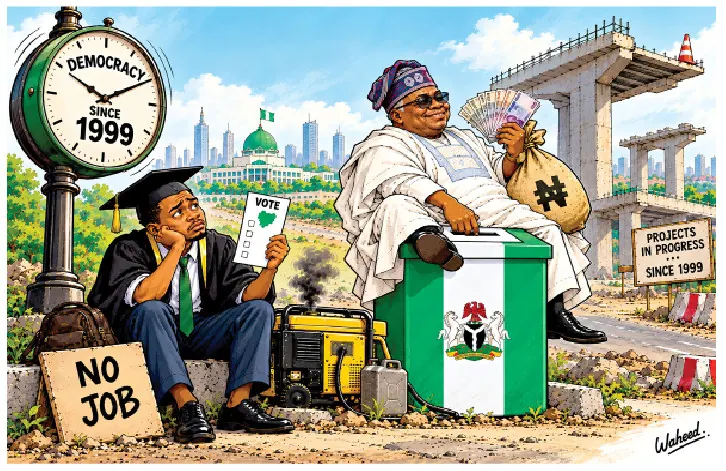
A Nigerian born in 1999, the year democracy returned, is now 27 years old and has never lived under a military government. However, they may have finished school and struggled to find a job, learned to plan trips around insecurity, and likely run a generator at home. This generation has grown up with democracy, but its impact on their lives is debatable. The country's Fourth Republic has achieved continuity, but the effectiveness of democratic institutions and citizen participation is uncertain.
Since 1999, Nigeria has had successive handovers of power, including the 2015 election where President Goodluck Jonathan lost and conceded. While this demonstrates some level of democratic maturity, it is only the beginning. Consolidation of democracy requires that institutions protect ordinary people, public money benefits the public, and those who abuse power face consequences. The test of democracy's strength lies in its ability to hold those in power accountable.
The concept of continuity trap suggests that a system that rewards insiders gives them little reason to change it. Politicians who benefit from expensive nomination forms, opaque campaign funding, and weak oversight have little incentive to widen access. Each election that renews their influence confirms that the arrangement works. However, citizens experience this as dysfunction, and insiders regard it as a successful bargain.
The costs of this system are scattered, while rewards are concentrated. One community loses a clinic, another a road, while beneficiaries know what reform could cost them. Citizens must connect their separate disappointments into sustained demands for better government. This explains how Nigeria can have so much politics and so little service, with parties organizing lavish conventions while hospitals lack medicines.
Institutions should correct this imbalance by protecting voters' choices, scrutinizing executives, and defending rights. Their independence has a practical test: can they act when doing so inconveniences those who appoint or fund them? The 2023 presidential election exposed the stakes, with results not appearing on INEC's Results Viewing Portal as promptly as expected.
The maturity of democracy is measured by its ability to protect citizens' rights and ensure accountability. Presidents must accept restraint, opposition parties must be able to compete, and judges must rule without intimidation. Citizens must obtain justice without relying on a godfather. The system's learning and who benefits from it are crucial in determining the trajectory of Nigeria's democracy.
Ultimately, time alone cannot deliver democratic consolidation; institutions must grow stronger. Repeated elections may teach politicians to respect competition or manipulate it better. The challenge for Nigeria's democracy is to move beyond mere continuity and ensure that institutions serve the people, not just the interests of those in power.
Key points
- Nigerian democracy needs stronger institutions to protect citizens' rights and ensure accountability.
- The country's Fourth Republic has achieved continuity but not necessarily consolidation of democracy.
- Citizens must connect their disappointments into sustained demands for better government.