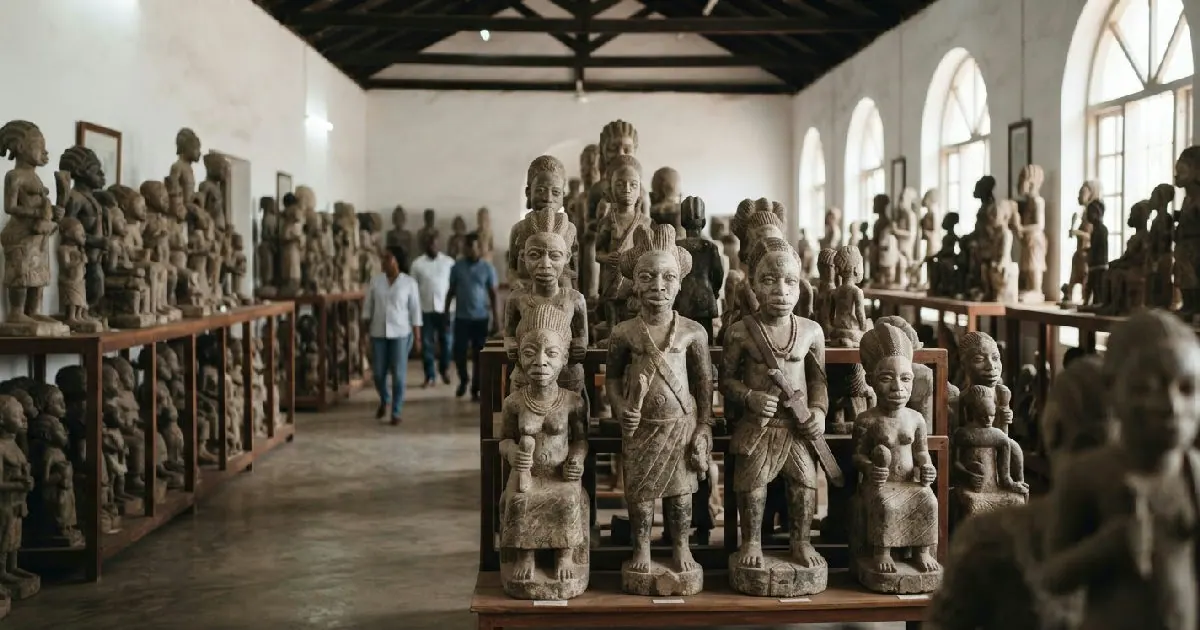
In 1945, the colonial administration established Nigeria's first museum in Esie, Kwara State, to house a collection of mysterious stone figures. The museum was built around an unexplained collection of human-like carvings, depicting men, women, and children with elaborate hairstyles, ornaments, and various implements. This development marked a significant cultural milestone, pitting local oral traditions against emerging archaeological inquiries, shaping Nigeria's approach to its heritage.
The stone figures were central to Esie's local lore long before the official museum was established. According to oral tradition, a hunter named Baragbon stumbled upon the remarkable sight in the forest around 1775. He found numerous stone figures, some arranged in striking circular formations, with a prominent central piece. Baragbon's discovery transformed a remote forest site into one of Nigeria's most intriguing cultural locations, setting the stage for generations of speculation.
The Esie community consulted Ifa, the Yoruba divination system, to explain the mysterious figures. An extraordinary explanation emerged: these were once human beings, transformed into stone as punishment for their disobedience. This traditional belief deeply embedded the figures within a sacred history, acquiring profound religious significance and influencing community practices and beliefs for centuries. The site became a living, revered past, rather than just archaeological curiosities.
Archaeologists and art historians presented a different view, identifying the figures as soapstone, a soft material ideal for carving, and dating their creation to between the 12th and 15th centuries, predating their "discovery" by hundreds of years. This implied a sophisticated ancient artistic tradition, though the identity of the carvers remained elusive. The figures' intricate details, including diverse hairstyles, facial markings, and adornments, hinted at a structured society.
The Esie figures first drew wider official attention in 1933, when H. G. Ramshaw, a Church Missionary Society inspector, reported them to the colonial authorities. This marked a turning point, moving the site from local reverence to administrative interest. By 1945, the colonial administration decided to establish Nigeria's first museum directly at Esie, acknowledging the immense cultural value of the figures and the need for their preservation.
The Esie Museum introduced a new method for documentation, conservation, and public display, demonstrating that Nigeria possessed a rich cultural tapestry that demanded dedicated institutional protection. The museum system intersected community heritage and modern preservation, showcasing a unique blend of traditional Nigerian communities' preservation methods and modern approaches.
Today, the Esie Museum stands as a living testament to Nigeria's deep and complex history, serving as a reminder that the nation's heritage stretches back centuries before colonial influences or written records. The enduring mystery of the Esie stone figures continues to challenge and fascinate, compelling a critical examination of both oral traditions and archaeological evidence, and offering a richer understanding of this unique Nigerian treasure.
Key points
- The Esie Museum was established in 1945 to house a collection of mysterious stone figures.
- The stone figures were created from soapstone between the 12th and 15th centuries.
- The museum represents a foundational moment for national heritage management in Nigeria.