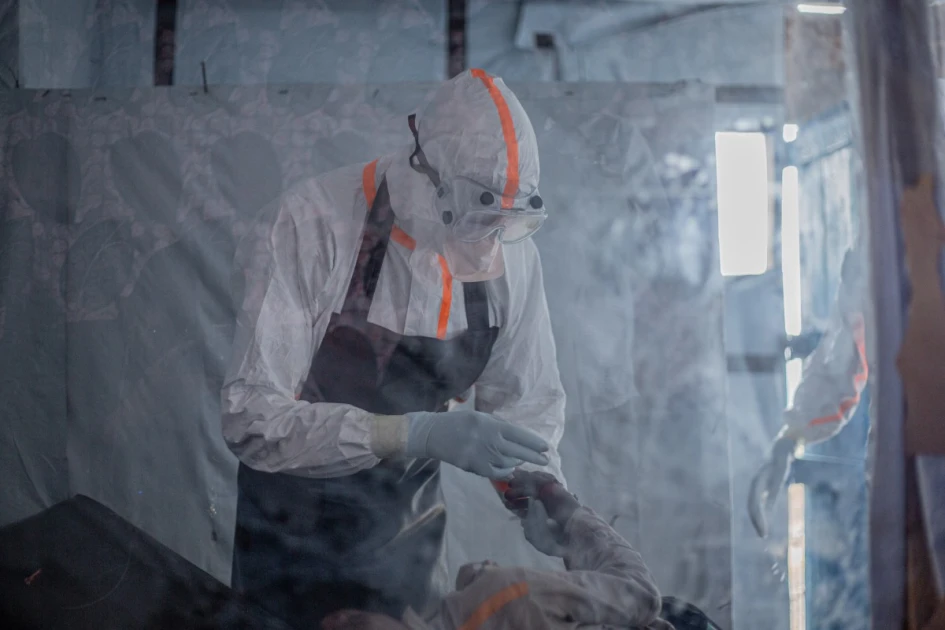
Genomic tests have revealed that the Ebola virus found in Nigeria's first case bears a strong resemblance to the one identified in Kenya's first case earlier this month. Nigeria's health minister, Muhammad Ali Pate, announced this information at a press conference, providing insight into the possible connection between the two cases. The Nigerian case involves the wife of a staff member at Switzerland's embassy in Abuja, who had returned from Uganda on October 3.
The wife of the Swiss embassy staff member was confirmed as Nigeria's first Ebola case on Tuesday. Contrary to earlier reports, the Swiss foreign ministry clarified that she had not visited the Democratic Republic of Congo, the epicentre of the current outbreak. Health authorities are working to determine the source of her infection, with Africa Centres for Disease Control and Prevention suggesting a possible link to Kenya's first patient at the airport.
Kenya's first patient and Nigeria's first patient both flew from Uganda on the same day, sparking concerns about a potential connection between the two cases. However, Health Minister Pate emphasized that there is no evidence of travel links between the two patients. The genomic analysis suggests that the Nigerian case "appears to be closely related to the case identified in the index case in Kenya," Pate stated.
The current Ebola outbreak, caused by the Bundibugyo species, has spread to four African countries: the Democratic Republic of Congo, Uganda, Kenya, and now Nigeria. The epidemic, which began in the northeastern DRC in May, has resulted in over 9,700 confirmed cases and 4,690 deaths, according to WHO figures as of October 20. The situation remains a concern for health authorities across the continent.
In Uganda, 20 confirmed cases, including two deaths, were recorded before the outbreak was officially declared over in August. The situation in Kenya is also being closely monitored, with the Ministry of Health recently announcing a second Ebola death in the country. Health authorities are working to contain the outbreak and prevent further spread.
The Africa Centres for Disease Control and Prevention is playing a crucial role in tracing the source of the infection and preventing further spread. The organization has been working closely with national health authorities to monitor the situation and provide support where needed. The Nigerian government has also been working to ensure that all necessary measures are in place to contain the outbreak.
The World Health Organization (WHO) continues to provide updates on the epidemic, which has now spread to four African countries. With the number of confirmed cases surpassing 9,700, the situation remains a concern for global health authorities. The WHO and other health organizations are working together to support affected countries and prevent further spread of the disease.
Key points
- Nigeria's first Ebola case is highly similar to Kenya's first case, according to genomic tests.
- The current Ebola outbreak has spread to four African countries: DRC, Uganda, Kenya, and Nigeria.
- The epidemic has resulted in over 9,700 confirmed cases and 4,690 deaths, according to WHO figures as of October 20.