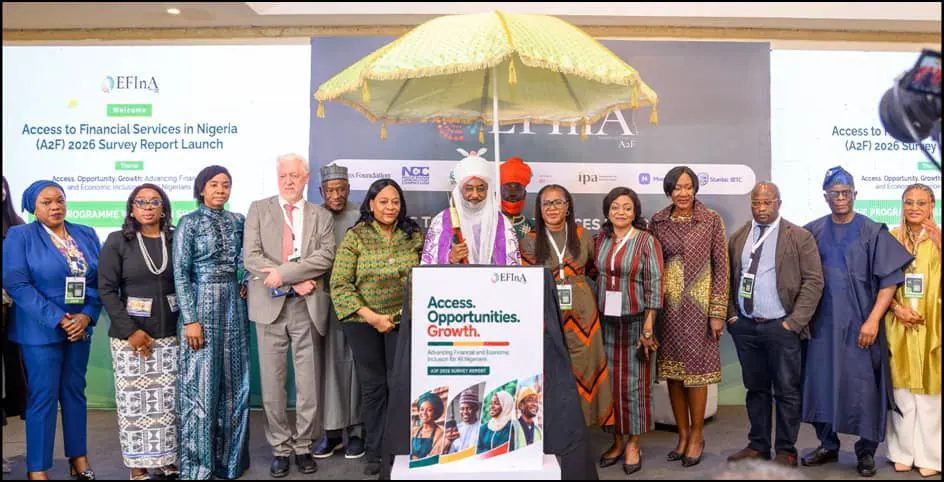
Enhancing Financial Inclusion and Advancement (EFInA) has released the findings of its ninth Access to Financial Services in Nigeria (A2F) Survey, showing that 79% of Nigerian adults, representing approximately 94.2 million people, now use a financial product or service. The survey, released on September 16, 2026, also showed that formal financial inclusion had reached 73%, or roughly 87.2 million adults, exceeding the 70% target set under the National Financial Inclusion Strategy.
The findings were presented under the theme, “Access. Opportunity. Growth: Advancing Financial and Economic Inclusion for All Nigerians,” before senior government officials, regulators, financial service providers, development partners, and civil society organisations. The programme opened with pre-event breakout sessions focused on women’s economic and financial inclusion, agricultural livelihoods, and financial resilience. These sessions were convened with the World Bank Global Environment Facility Small Grants Program (GEF SGP), Deutsche Gesellschaft für Internationale Zusammenarbeit (GIZ), and Innovations for Poverty Action (IPA), respectively.
Dr. Agnes Olatokunbo Martins, Board Chair, EFInA, said the theme captured both the progress made and the ambition that should guide the next phase of Nigeria’s financial inclusion journey. She described the value of the survey as its ability to show what administrative data cannot, explaining that while administrative data can provide information on accounts, transactions, infrastructure, and providers, the A2F survey provides insight into the people behind those numbers. Martins cautioned against designing policies around a national average, noting that financial needs and experiences differ by income, gender, geography, age, and economic activity.
In a keynote address delivered on behalf of Mr. Olayemi Cardoso, Governor of the Central Bank of Nigeria, Dr. Aisha A. Isa-Olatinwo, Director, Consumer Protection and Financial Inclusion, CBN, said the evidence produced by the survey was indispensable to policy design, market development, consumer protection, and the effective targeting of reforms. The address highlighted a shift in what the sector should now be working towards, emphasising the need to ensure meaningful usage, affordability, reliability, safety, trust, and measurable improvement in financial health.
The survey found that digital financial services had reached 64.4% of adults, up from 45% in 2023 and 34% in 2020. The rise represents the largest movement recorded in the latest survey, with digital use also tracking closely with better financial outcomes. The survey found that 33% of digital users were financially healthy, compared with 9.1% of non-users. On financial health, Foyinsolami Akinjayeju, CEO, EFInA, noted that “three out of four Nigerians are not financially healthy,” adding that access was increasing while financial health was not catching up at the same pace.
Dr. Oluwatomi Eromosele, Research Lead, EFInA, said the next phase of financial inclusion should focus on precision, conversion, and outcomes. “The message from A2F 2026 is clear: Nigeria’s financial inclusion challenge has changed. The next phase must be about precision: reaching the people and places where gaps remain; conversion: turning existing financial relationships into pathways to credit, protection, investment, and financial security; and outcomes: ensuring that inclusion ultimately strengthens people’s resilience and economic opportunity.”
Amb. Nimi Akinkugbe, Member, EFInA, said the real measure of the survey would not be the quality of the data unveiled but what changes as a result of it. She asked where resources would be directed, which interventions would be scaled, and what stakeholders would be able to say had changed in the lives of Nigerians by the time they next met. Akinkugbe also drew attention to the gender findings across the zones, noting that formal inclusion gaps between men and women were often modest, while inclusion was not translating into financial health and resilience at the same rate.
Key points
- Formal financial inclusion in Nigeria has reached 73%, exceeding the 70% target set under the National Financial Inclusion Strategy.
- Digital financial services have reached 64.4% of adults in Nigeria, up from 45% in 2023 and 34% in 2020.
- Three out of four Nigerians are not financially healthy, with access to financial services increasing while financial health is not catching up at the same pace.