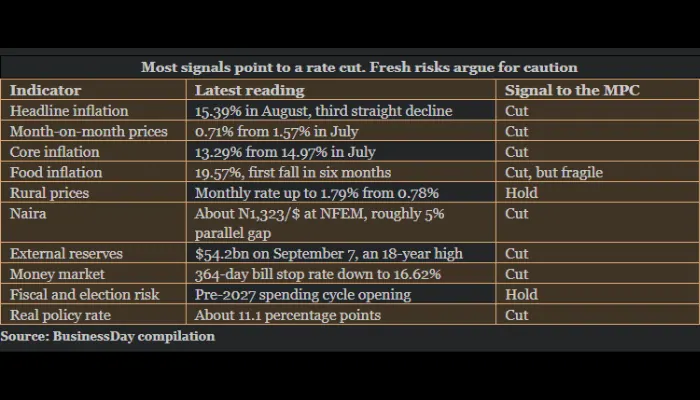
The Central Bank of Nigeria's Monetary Policy Committee is set to convene for its 307th meeting, with a stronger case for easing monetary policy than at its previous two meetings. Inflation has declined for three consecutive months, with headline inflation falling to 15.39 percent in August from 15.43 percent in July and 15.91 percent in June. This trend is expected to influence the committee's decision on whether to cut interest rates.
The National Bureau of Statistics reports that inflation has declined by 7.75 percentage points from its peak of 23.14 percent recorded a year earlier. Monthly inflation has slowed sharply, with month-on-month inflation declining to 0.71 percent in August from 1.57 percent in July. Core inflation has also fallen to 13.29 percent from 14.97 percent, while food inflation declined to 19.57 percent, its first fall in six months.
The disinflation trend is evident across various sectors, with food inflation's monthly rate dropping sharply to 1.02 percent from 5.56 percent. However, food inflation remains elevated, with rural month-on-month inflation accelerating to 1.79 percent in August from 0.78 percent. Year-on-year food inflation remains high in some states, with Adamawa and Zamfara recording 38.85 percent and 37.96 percent, respectively.
Economists have varying opinions on the likely outcome of the Monetary Policy Committee's meeting. Abayomi Fashina, Group Risk Manager at STL Capital, expects a 50-basis-point reduction in the policy rate, citing softer inflation and declining market rates. In contrast, Faruq Quadri, economist at SPEC-Matrix, believes the committee will hold the rate due to renewed energy-price pressures and the approaching election cycle.
The approaching election cycle and renewed energy-price pressures are significant factors that could influence the committee's decision. Crude oil prices have risen sharply, and this is already feeding into transport fares. Higher liquidity could complicate the inflation outlook, making it challenging for the committee to decide on a rate cut. Idris Oyekan, capital market and credit rating analyst at Quantum Zenith, expects the committee to hold the policy rate at the current level due to external transmission of renewed geopolitical tensions.
Muda Yusuf, chief executive of the Centre for the Promotion of Private Enterprise, argues that keeping rates high is distorting financial intermediation, while easing too soon would risk reigniting inflation. He believes that a significant share of the remaining inflation pressure is structural rather than monetary, making it challenging for the committee to decide on a rate cut or hike. The committee's decision will depend on its confidence in the durability of the disinflation trend.
The Central Bank of Nigeria's policy rate has been at 26.5 percent since February, when it was cut by 50 basis points. Gross external reserves stood at $54.209 billion on September 7, while the naira has traded around N1,320 to the dollar at the official window. Remittances through licensed operators reached a record $947 million in July, providing a stable source of foreign exchange.
Key points
- Nigeria's inflation rate has fallen for three consecutive months.
- The Central Bank of Nigeria's Monetary Policy Committee is expected to decide on a rate cut or hold.
- Renewed energy-price pressures and the approaching election cycle are significant factors that could influence the committee's decision.