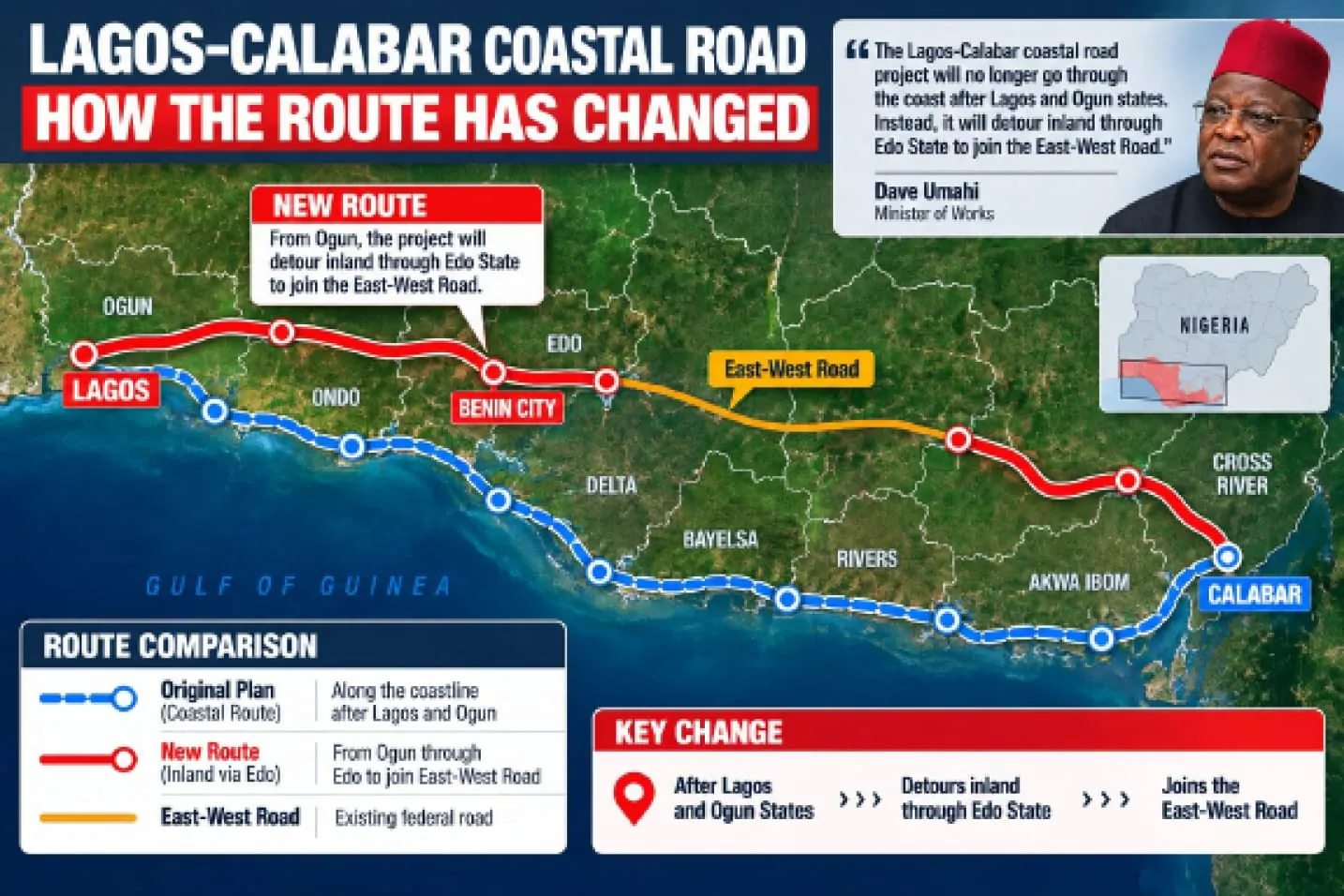
The Nigerian federal government has defended its decision to divert part of the Lagos-Calabar Coastal Highway through the East-West Road corridor, citing engineering challenges and cost savings. Minister of Works, Senator David Umahi, explained that the original alignment through Ondo State presented significant engineering challenges, including deep pits and unsuitable terrain that would have substantially increased construction costs. The decision to redesign the route was guided by technical assessments, not politics, Umahi insisted.
The Lagos-Calabar Coastal Highway is a signature project of President Bola Ahmed Tinubu's administration, aimed at easing commuting from Lagos to Calabar. The project was commissioned in May 2025, with the first phase completed, a four-lane highway from Victoria Island, Lagos, built with concrete pavement. The original design passed through six states: Ogun, Ondo, Delta, Bayelsa, Rivers, and Akwa-Ibom. The project has received significant funding, with a $747 million budget, including a $47 million external loan approved in 2025.
According to Umahi, the terrain along the original alignment was unsuitable for conventional road construction due to deep pits and lack of suitable sharp sand. He explained that constructing a road through such terrain would have been costly, with the cost of one kilometer being significantly higher than a road passing through normal terrain. The ministry undertook a detour and redesigned the route to avoid the difficult terrain, with filling work almost concluded.
The diversion affects Sections 4A and 4B of the coastal highway, covering 67 kilometers, comprising 27 kilometers in Ogun State and 40 kilometers in Ondo State. The section will terminate around the Ondo-Edo axis. Umahi provided an update on the wider project, stating that Section 1, a 47.47-kilometer stretch from Victoria Island, Lagos, was completed and ready for commissioning. Section 2, covering 55 kilometers, would be completed next month.
Umahi also discussed the challenges faced in Section 2, including the need for extensive redesign of flyovers, overpasses, and underpasses, particularly around the Dangote Refinery and Lekki Deep Seaport. An 86-meter-span bridge was designed to accommodate refinery trucks and resolve traffic conflicts. At the Calabar end, Sections 3A and 3B, covering 65 kilometers, had achieved over 30 percent completion.
Construction is ongoing on Section 5, an 82-kilometer dual carriageway in Akwa Ibom State. Additionally, work is progressing on an 88-kilometer link from Calabar to Ebidi Beach, intended to connect with the Trans-Saharan route. Despite Umahi's explanations, the diversion of Sections 4A and 4B may remain a subject of public scrutiny, given the project's strategic importance and substantial public resources committed.
Experts have raised concerns about the planning, environmental implications, and long-term accessibility of the Lagos-Calabar Coastal Highway. A former chairman of the Nigerian Society of Engineers, Engr. Akintayo Akintola, questioned whether adequate feasibility studies and environmental assessments were conducted before construction began. Akintola argued that the debate should extend beyond construction costs to include original planning assumptions, environmental consequences, and the road's intended benefits.
Key points
- The Nigerian federal government has diverted part of the Lagos-Calabar Coastal Highway due to engineering challenges and cost savings.
- The project has received significant funding, with a $747 million budget, including a $47 million external loan approved in 2025.
- Experts have raised concerns about the planning, environmental implications, and long-term accessibility of the Lagos-Calabar Coastal Highway.