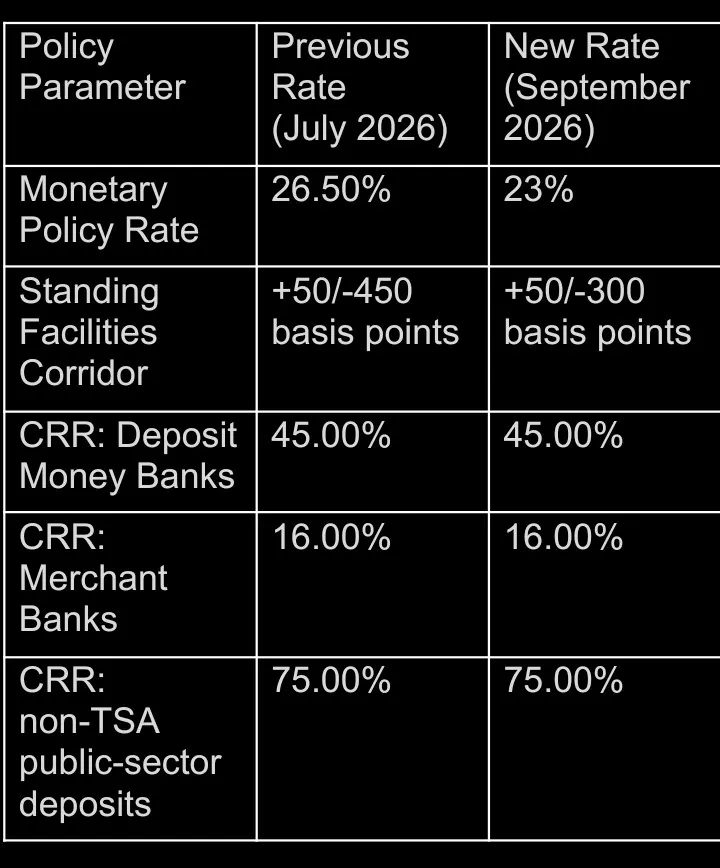
The Central Bank of Nigeria has made a significant policy adjustment, lowering the Monetary Policy Rate (MPR) to 23.0% from 26.5%, a 350-basis-point reduction. This move marks one of the biggest policy rate adjustments in years. Despite the large cut, the Central Bank characterizes it as an operational reset rather than the beginning of an aggressive easing cycle. The immediate objective is to reconnect the policy rate with prevailing money-market rates and improve monetary-policy transmission.
The Monetary Policy Committee (MPC) also recalibrated the standing facilities corridor to +50/-300 basis points. This change is expected to have a bigger near-term effect, potentially leading to a repricing of money-market instruments, government securities, and banks' treasury positions. The Committee retained all Cash Reserve Requirement (CRR) parameters, indicating that the Central Bank remains cautious and intends to balance the objective of supporting economic activity with the need to preserve macroeconomic stability.
The decision to reduce the MPR by 350 basis points likely reflects the MPC's assessment that inflation risks have moderated sufficiently to permit a gradual easing of monetary conditions. Following an extended period of monetary tightening, headline inflation has shown a sustained downward trajectory, reducing the need for an exceptionally restrictive policy stance. This development provides the MPC with greater policy space to shift some attention toward supporting growth while continuing to monitor inflation risks.
The move may also indicate growing confidence in recent improvements in macroeconomic conditions, including the moderation in inflation and relative stability in the foreign exchange market. By lowering the policy rate, the MPC seeks to ease financial conditions, stimulate credit creation, and support consumption and investment without completely abandoning its commitment to price stability. The reset creates scope for borrowing costs to decline, but the pass-through to bank lending rates is unlikely to be immediate or one-for-one.
Unchanged reserve requirements, elevated funding costs, and borrower-specific risk premiums will continue to influence the price and availability of credit. The decision does not necessarily signal the end of monetary restraint, as the retention of other policy parameters suggests that the MPC remains cautious. The policy will succeed if the MPR regains control of short-term market rates, the naira remains broadly stable, and disinflation continues while private-sector credit improves.
The reduction in the MPR may reduce the attractiveness of naira-denominated assets relative to foreign assets, potentially weakening capital inflows and increasing pressure on the exchange rate. If the naira depreciates, the domestic cost of imported consumer goods, raw materials, machinery, and other production inputs could rise, contributing to imported inflation. However, the overall impact on the exchange rate will also depend on factors such as foreign exchange inflows, oil prices, external conditions, and investor confidence.
For economic decision-makers, the message is to prepare for lower market yields, negotiate harder on borrowing costs, and retain protection against inflation and currency risk. The policy shift is best understood as a recalibration of Nigeria's monetary-policy architecture, not an unconditional pivot to easy money. It should lower some market rates and may gradually improve financing conditions, but unchanged reserve requirements mean that liquidity remains constrained and bank credit is unlikely to become cheap immediately.
Key points
- The Central Bank of Nigeria reduced the interest rate to 23% from 26.5%, aiming to reconnect the policy rate with money-market rates and improve monetary-policy transmission.
- The policy shift is characterized as an operational reset rather than the beginning of an aggressive easing cycle.
- The decision does not necessarily signal the end of monetary restraint, as the retention of other policy parameters suggests that the MPC remains cautious.