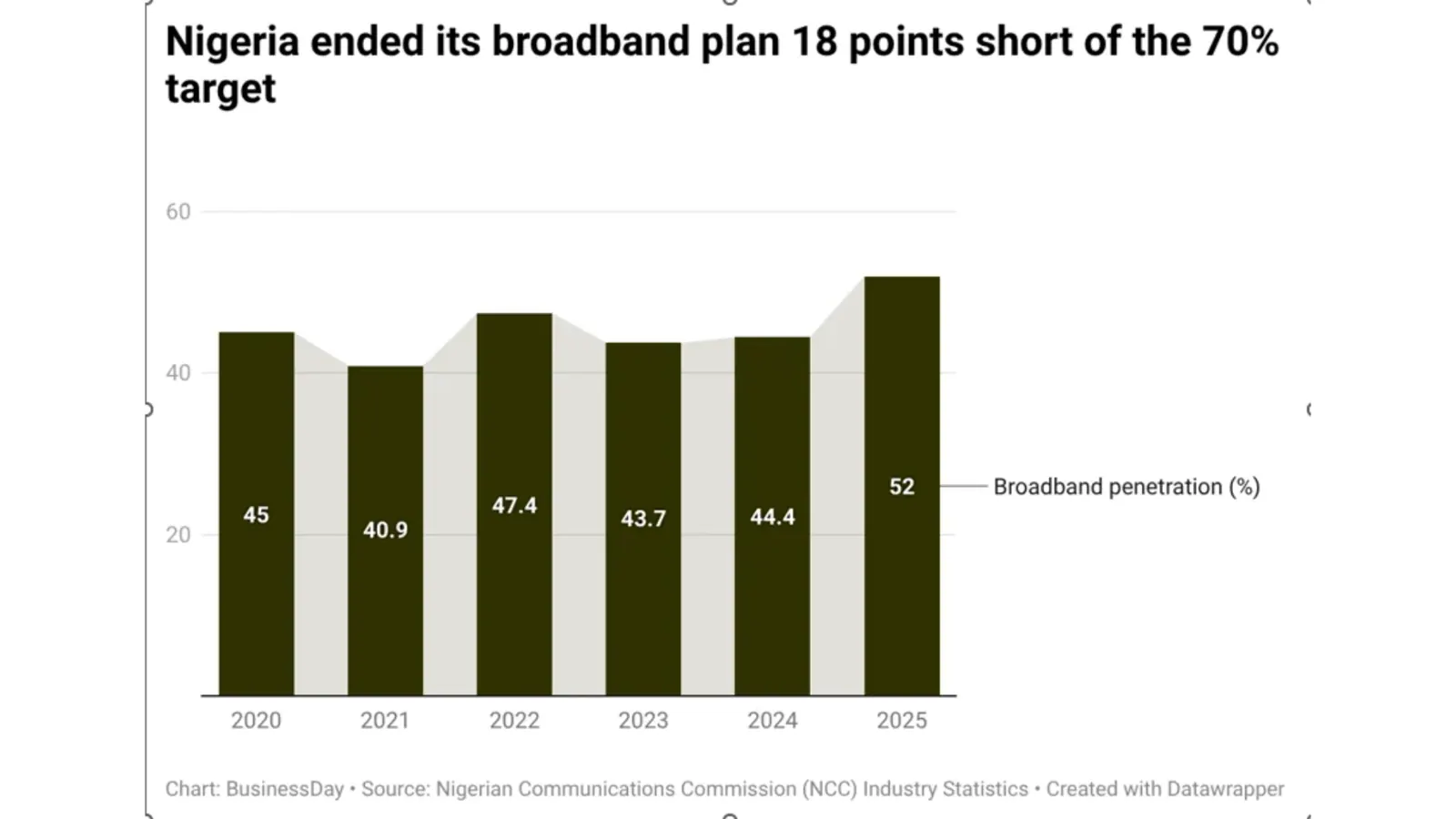
Nigeria's five-year broadband strategy ended with the country well short of its central access target, leaving a large gap between the digital infrastructure built and the number of Nigerians able to participate fully in the digital economy. The National Broadband Plan 2020-2025 set ambitious targets, including 70% broadband penetration by 2025, 90% effective broadband population coverage, and minimum download speeds of 25 Mbps in urban areas and 10 Mbps in rural areas.
The plan, led by Funke Opeke, chief executive of MainOne, and co-chaired by Bashir Gwandu, a former NCC executive commissioner, aimed to go beyond simply increasing internet connections. It targeted 70% of mobile subscriptions using 4G by 2023 and locally assembled, affordable smart devices. The device ambition was specific, with at least one locally assembled smart device by 2023 at a price below $50, or about N18,000.
Nigeria entered the 2020-2025 period with broadband penetration already at 45.02% in December 2020. However, progress was uneven, with penetration falling to 40.88% in 2021, recovering to 47.36% in 2022, slipping to 43.71% in 2023, and ending 2024 at 44.43%. The recovery accelerated in 2025, with broadband penetration reaching 51.97%, but still 18.03 percentage points below the 70% target.
The same gap appears in 4G adoption, with the plan targeting 70% of mobile subscriptions using 4G by 2023. By December 2025, the share stood at 52.95%. Network performance provides a more positive part of the story, with average 4G download speeds reaching about 33 Mbps in 2025, above the plan's 25 Mbps urban benchmark.
However, an average speed is not the same as a minimum national standard. Independent measurements show faster networks, but their results differ. Ookla's Speedtest Global Index recorded Nigeria's median mobile download speed at 44.14 Mbps in the fourth quarter of 2025, while nPerf recorded average mobile download speeds rising from about 7.1 Mbps in early 2023 to 14.7 Mbps by late 2025.
Coverage improved, but the rural gap remains. GSMA Intelligence estimated Nigeria's 4G population coverage at 84% in 2024, while rural 4G population coverage was only about 48%. The available coverage figures should not be presented as definitive proof that Nigeria either achieved or missed the plan's 90% effective population-coverage target.
The next phase of broadband policy will focus on converting infrastructure into affordable, reliable, and widespread use. With 5G accounting for 3.77% of mobile connections in December 2025, and active mobile subscriptions falling from about 224.7 million in December 2023 to 164.9 million in December 2024, the challenge is to ensure that the digital economy is accessible to all Nigerians.
Key points
- Nigeria's broadband penetration reached 51.97% in December 2025, short of the 70% target.
- The country's 4G adoption target was also missed, with 4G accounting for 52.95% of mobile subscriptions at the end of 2025.
- The next phase of broadband policy will focus on converting infrastructure into affordable, reliable, and widespread use.