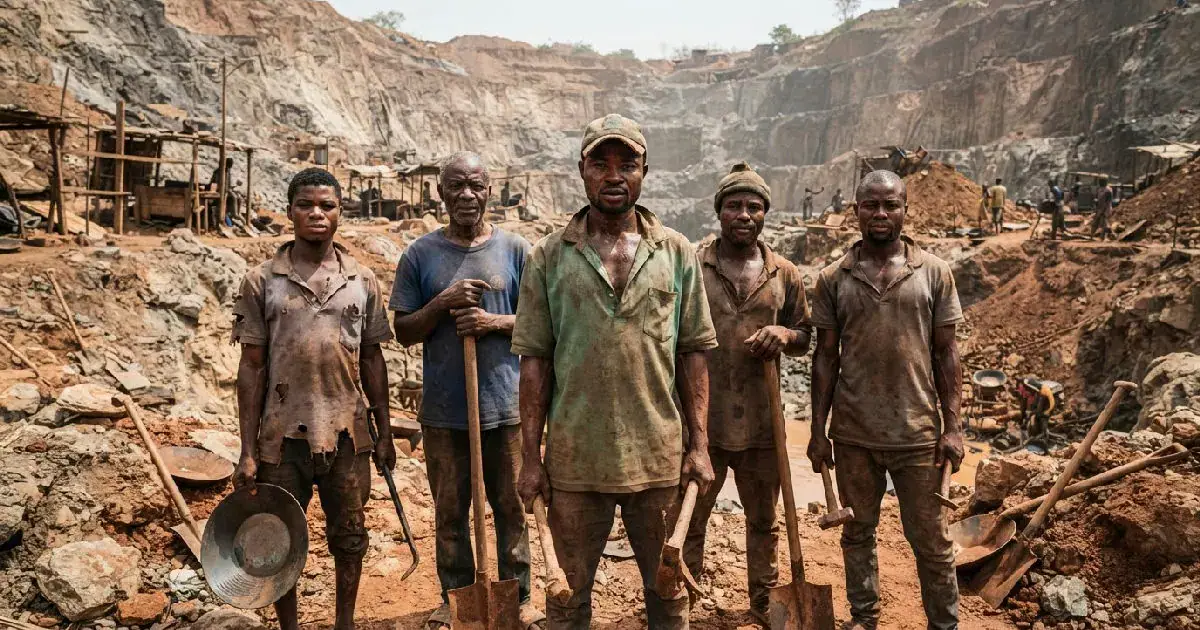
For decades, Nigeria's artisanal mining sector has been subject to military-style raids and punitive crackdowns, a policy approach that has driven the sector into the shadows. This approach, based on a belief that artisanal miners are simply thieves, has failed to grasp the reality that for millions, artisanal and small-scale mining is a desperate livelihood, an escape from poverty where no other options exist. An estimated 90% of these miners operate informally, without the permits their governments make nearly impossible to obtain.
The consequences of this policy have been devastating. The criminalisation of artisanal miners has created a power vacuum that has been quickly filled by organised criminal syndicates. These gangs extort "taxes" and "protection money" from vulnerable miners, and violence has become the norm. In South Africa, turf wars between rival syndicates exploiting artisanal miners, known as "Zama Zamas," led to hundreds of deaths between 2012 and 2015 alone. This approach has also led to a pattern of poor governance that has plagued development sectors.
The roots of this criminalisation trap stretch deep into the past. Post-colonial governments inherited and often expanded upon colonial-era laws that viewed natural resources primarily as state assets to be centrally controlled. This framework often left little room for traditional, small-scale mining practices that sustained countless rural communities. The underlying assumption was that all informal mining represented a threat to national sovereignty and economic stability. Instead of creating pathways for legal participation, policies focused on exclusion and punishment.
The human cost of this policy failure has been tragic. In September 2026, 37 young men, arrested as "illegal miners," died in the custody of the Nigeria Security and Civil Defence Corps (NSCDC) in Minna, Niger State. An investigation found their deaths from overcrowding and neglect were "entirely preventable." These individuals were not master criminals, but victims of a failed strategy that conflated poverty with criminality. The state's focus on punishment created a system where human rights were an afterthought.
The economics of neglect have also been staggering. While governments spent vast sums on enforcement, they simultaneously lost out on immense potential revenue. In 2022, the artisanal and small-scale mining sector accounted for a staggering 32% to 41% of Africa's total gold production. In South Africa alone, the value of lost gold production due to illegal mining activities was estimated to exceed R14 billion annually. This wealth, instead of flowing into national treasuries for development, was siphoned off by criminal syndicates.
The Nigerian experience is not an isolated incident, but a reflection of a broader pattern across Africa. In Ghana, a government ban on "galamsey" (illegal artisanal mining) in 2017 initially reduced operations, but led to miners relocating to forest reserves and new territories, intensifying environmental degradation. The Democratic Republic of Congo (DRC) also grappled with these issues, leading to reforms like the 2018 Mining Code. However, enforcement failures and structural gaps in legislation often meant abuses continued, and miners remained vulnerable.
Experts argue that formalisation is the enduring solution to the challenges of artisanal mining in Africa. This involves providing appropriate licenses for small miners, offering safety training, and facilitating access to geological information. Creating official mineral-buying centers would also curb illicit trade. Such an approach would distinguish between the millions mining for survival and the violent syndicates preying on them, addressing underlying issues like poverty and a lack of alternative employment.
Key points
- The Nigerian government's policy of criminalising artisanal miners has led to a "criminalisation trap" that has driven the sector into the shadows, creating a power vacuum that has been exploited by organised criminal syndicates.
- The human cost of this policy failure has been tragic, with 37 young men dying in custody in 2026 due to overcrowding and neglect.
- Formalisation of the artisanal mining sector is seen as a potential solution, involving the provision of licenses, safety training, and access to geological information.