Nigeria's agricultural sector faces significant challenges, including post-harvest losses estimated at 30-50 per cent of harvests. The Special Agro-Industrial Processing Zones programme, approved in 2021, aims to address this issue by building factory estates near farming areas. The programme's first phase, valued at $538.05m, was expected to be completed by April 2027 but has faced delays. The African Development Bank's 2021 plan expected building work to be half done by the third quarter of 2024 and largely finished by early 2025.
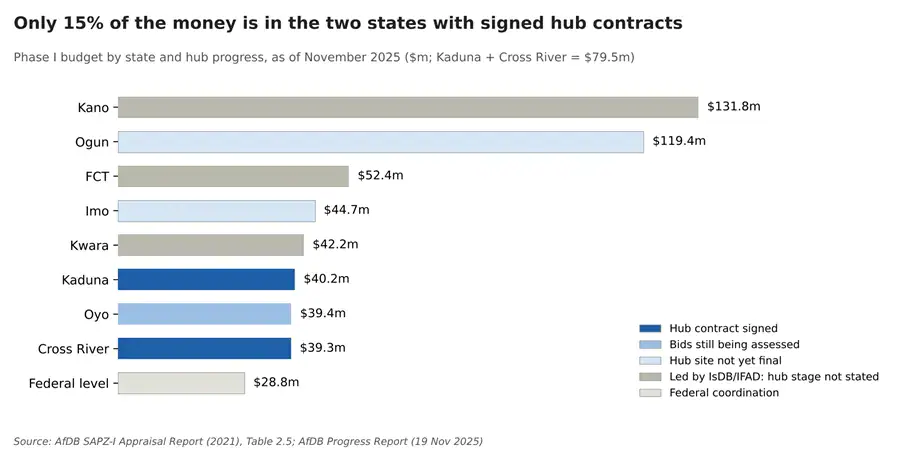
The programme's delays began early, with the International Fund for Agricultural Development making its first payment only in November 2023. As of November 2025, only Kaduna and Cross River had signed contracts for companies to design, build and run their hubs. Oyo was still assessing bids, while Ogun and Imo were still settling on hub sites and completing environmental studies. The programme office's records show that progress was slow, with the AfDB's progress report stating that the programme had not advanced far enough to measure its outcomes.
The programme aims to create eight factory hubs, each supplied with roads, power, water and internet, and 15 Agricultural Transformation Centres. The promised results were ambitious, including about $1bn in private investment, hundreds of thousands of jobs, and post-harvest losses in the target areas cut from around 50 per cent to 10-20 per cent. However, the planning documents are not always consistent, with different job numbers quoted in different places.
The AfDB's November 2025 report shows that only about 8 per cent of its own $210m package had been paid out, roughly $17m as of 10 November 2025. The programme's financing plan shows that foreign lenders provide $520m and Nigeria's federal and state governments just $18.05m, making Nigeria's own share 3.4 per cent. The AfDB normally expects a borrower to fund at least half of a programme but waived that rule here, citing the pressure on Nigeria's public finances after Covid-19.
Delay also has a price, with lenders typically charging a small yearly fee on loan money that has been approved but not yet used. A fee of 0.25 per cent a year on $200m of unused money would cost about $500,000 a year. The real figure depends on each loan's terms and how much remains unspent. The appraisal's year-by-year spending plan adds up to $539.21m, about $1.16m more than the headline cost.
On 1 December 2025, the AfDB board approved $200m as the first instalment of SAPZ Phase II, covering 10 more states. The full plan aims to reach 27 states over three instalments. The Bank says the expansion will keep up momentum and attract private investment, with jobs for young people and women. Starting a second phase before the first is finished is not wrong in itself; large infrastructure programmes often involve multiple phases.
The test of this programme is whether produce goes in and processed goods come out. What Nigeria signed up for is a programme that promises to reduce post-harvest losses and create jobs. The central point stands: progress should be judged by working factories, signed tenants, produce bought from farmers and jobs created, not by contracts and ceremonies. The programme's success will depend on its ability to deliver tangible results and meet its ambitious targets.
Key points
- The programme's delays and slow progress have raised concerns about its ability to meet its targets.
- The programme aims to create hundreds of thousands of jobs and reduce post-harvest losses in the target areas.
- The AfDB has approved a second phase of the programme, valued at $200m, to cover 10 more states.
Reporting sources
- The missing factories in Nigeria’s $538m farm plan · Business Day