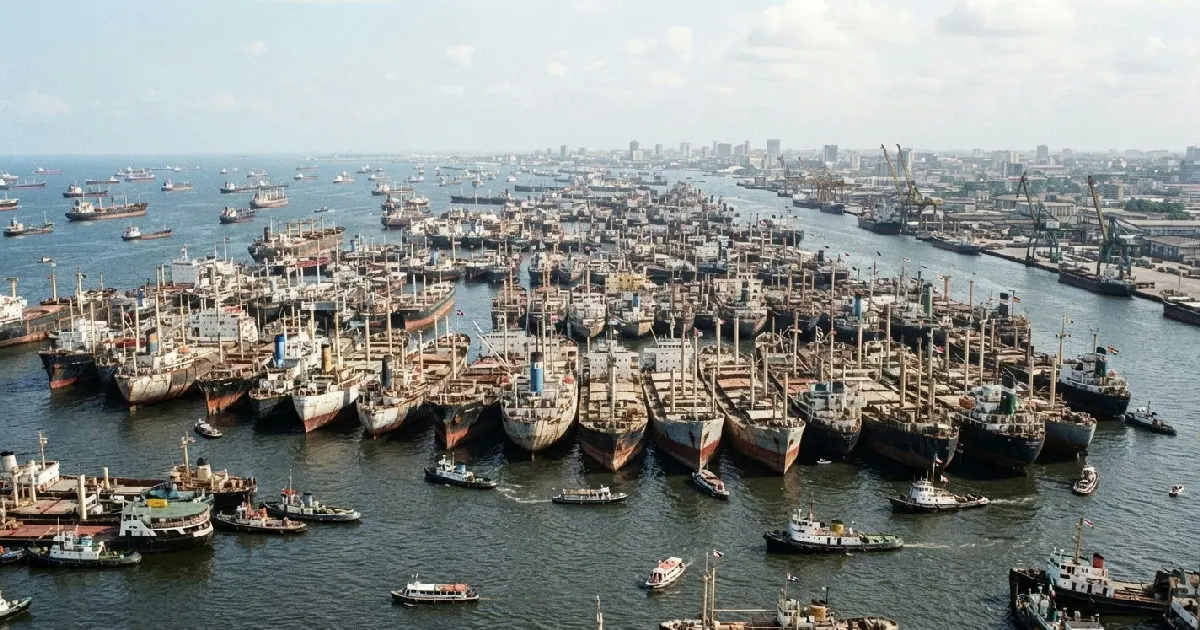
In mid-1975, a fleet of around 400 idle ships congregated off Lagos, creating a maritime traffic jam that crippled Nigeria's main port. This unprecedented congestion, dubbed the "Cement Armada," resulted from the country's plan to rebuild itself with newfound oil wealth. Following the Nigerian Civil War's end in 1970, Nigeria experienced a boom, with soaring petroleum revenues enabling General Yakubu Gowon's military government to fund a vast development program.
The development program included new military barracks, roads, and public housing, but these projects required enormous amounts of cement, far more than Nigeria could produce locally. The government's solution was to import cement, leading to a procurement and logistics disaster. The Federal Ministry of Defence, needing cement for a major barracks construction program, placed orders that eventually exceeded 16 million metric tonnes within a single year, far surpassing the country's capacity to handle.
A total of 109 contracts were signed with 68 different suppliers, committing Nigeria to buying over 16 million metric tonnes of cement at a cost approaching one billion dollars at the time. However, the Port of Lagos, Nigeria's principal maritime gateway, had an operational capacity for unloading bulk cargo like cement estimated at just one million metric tonnes per year. This created an impossible logistical challenge, and the contracts contained expensive demurrage clauses that required Nigeria to pay shipping companies for every day their vessels were kept waiting.
As hundreds of ships queued at sea, unable to unload, Nigeria's bill for penalties skyrocketed, costing millions for cement it could not even receive. The congestion clogged berthing spaces, delaying other vital imports like food and industrial materials, transforming a cement problem into a wider economic bottleneck. This crisis demonstrated a crucial imbalance within Nigeria's rapidly developing economy, where money could be obtained faster than projects could be planned.
The cement crisis exposed the vulnerabilities of an underdeveloped bureaucracy struggling with sudden wealth and ambition. Nigeria had the money to purchase cement but lacked the developed systems necessary to manage such a massive procurement program efficiently. This fundamental flaw fed into growing discontent with General Gowon's administration, which was already facing widespread complaints of corruption, accumulation of wealth by officials, inefficiency, and the postponement of a promised return to civilian government.
The Cement Armada scandal significantly contributed to the climate that led to the July 29, 1975 military coup, which brought Brigadier Murtala Muhammed to power. The new government established a tribunal of inquiry under Justice M. B. Belgore to investigate the cement deals, examining how orders were made, why quantities became so large, and whether officials had personally benefited. The investigation transformed a logistical failure into a full-blown inquiry into Nigeria's corruption and accountability.
The crisis did not end when the ships stopped arriving, as its contractual consequences continued for years, leading to foreign suppliers and trading companies bringing claims against Nigeria in international courts. Major cases, including National American Corporation v. Federal Republic of Nigeria and Texas Trading & Milling Corporation v. Federal Republic of Nigeria, provided detailed accounts of the original procurement disaster, offering lasting lessons on the importance of effective planning and coordination in large-scale development projects.
Key points
- The Cement Armada crisis resulted from Nigeria's ambitious post-civil war rebuilding plan, which outpaced the country's administrative capacity.
- The crisis led to a significant change in government, with Brigadier Murtala Muhammed taking power in a military coup.
- The episode left a lasting impact on Nigeria's approach to large-scale development projects, highlighting the need for effective planning and coordination.