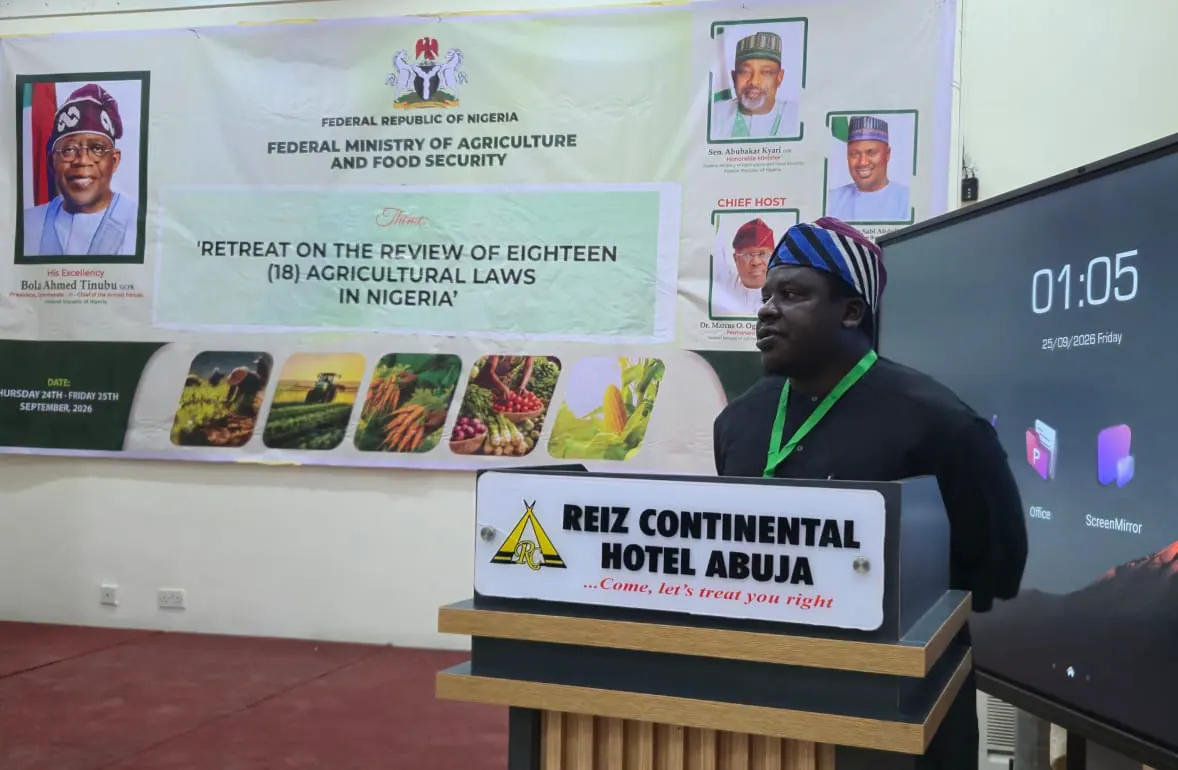
The Federal Ministry of Agriculture and Food Security (FMAFS) recently organized a two-day technical retreat to review 18 agricultural laws in Nigeria. The retreat, which took place on September 24 and 25, 2026, brought together participants from the Ministry of Justice, the House of Representatives Committee on Agriculture, and non-governmental organizations. The event aimed to unveil the reviewed laws and identify areas for improvement. The retreat was officially opened by the Director of Legal Services at the FMAFS, Hafsat Dupe Belgore Esq, who was represented by Manbyen Polycarp Mamvong Esq.
The review process involved a comprehensive diagnosis of existing agricultural legislation, which was completed in collaboration with relevant stakeholders. The goal was to identify obsolete provisions, overlapping mandates, regulatory gaps, and areas where existing laws no longer reflect current realities in the sector. The review also considered novel climate change laws and those covering modern food production aspects like mechanization, agricultural technology, and private-sector investment. Belgore emphasized the need for a more careful look at these areas to ensure that Nigeria's agricultural legal framework is practical, enforceable, and inclusive.
The second phase of the review involved a critical and decisive exercise to move the process from diagnosis to concrete legal reforms. Participants examined the reviewed laws, made critical inputs, validated findings, and drafted reform proposals. The goal was to align the review with the Renewed Hope Agenda, relevant national laws, and international best practices. The essence of the technical session was to refine the draft, interrogate draft provisions, and ensure that the new legal framework is capable of driving Nigeria towards food sovereignty and agribusiness-led economic growth.
The Chairman of the House Committee on Agriculture, Rt. Hon. Bello Ka'oje, re-echoed the importance of the retreat to the future of beneficial agricultural practices in Nigeria. Ka'oje restated the National Assembly's commitment to working with the FMAFS and other stakeholders to ensure that the outcome of the review translates into practical and effective legislation. The Deputy Chairman of the Committee, Hon. Kelechi Nwogu, represented Ka'oje at the event.
The dedication and diligence demonstrated by the syndicate groups during the technical session were noteworthy. Participants, including a Kenyan, approached the national assignment with uncommon patriotism. They were immersed in their assignments, working tirelessly to ensure that the reviewed laws attain some level of perfection. The lead consultant for the review project, Henry Maina Aliyu, deserves credit for delivering a well-organized retreat.
Some of the laws reviewed dated back to before independence and prescribed penalties that are no longer deterrent in today's context. For instance, some laws still prescribe penalties of just ₦1,000 for serious infractions. The review aimed to address such ambiguities and ensure that the laws are practical and enforceable. The Country Lead of Resilience Empowerment and Transformation (RET) Germany, Mr. Michael M. Muthama, also made a remarkable contribution to the review process.
The Permanent Secretary at the FMAFS, Dr. Marcus O. Ogunbiyi, commended participants for their service to the nation and restated the importance of the exercise. He charged delegates to be bold and brave in their recommendations, emphasizing that nothing can be more dangerous than a moribund law operating in a modern environment. The review of Nigeria's 18 agricultural laws has given stakeholders the opportunity to take a closer look at the work being done behind the scenes to ensure that Nigeria moves boldly into a future defined by intentional laws and policies.
Key points
- The review of Nigeria's 18 agricultural laws aims to drive food sovereignty and economic growth.
- The exercise involved a comprehensive diagnosis of existing agricultural legislation and a critical review of draft provisions.
- The reviewed laws aim to address obsolete provisions, overlapping mandates, and regulatory gaps in Nigeria's agricultural sector.