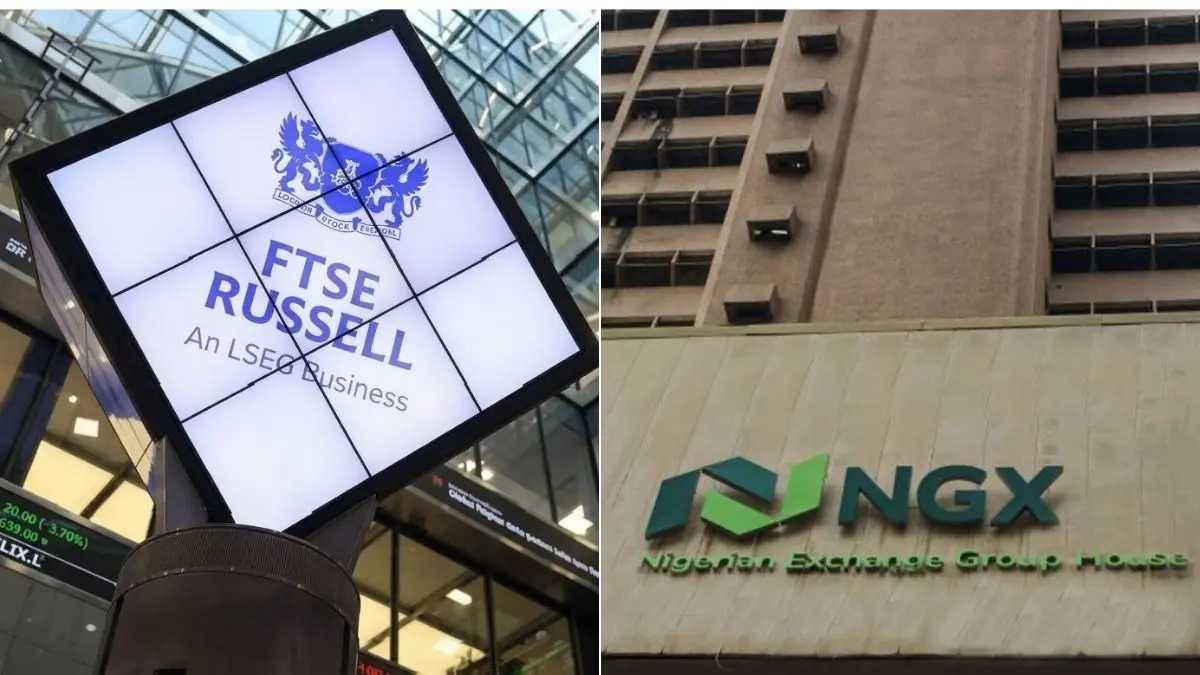
Nigeria's equities market returned to FTSE Russell's Frontier Market classification on Monday, September 21, bringing eligible Nigerian stocks back into the FTSE Frontier Index Series. This reclassification follows a review of Nigeria's market accessibility, foreign-exchange conditions, and transition to a T+1 settlement cycle. As a result, 31 Nigerian companies have been identified as eligible for the Frontier Index Series.
The Nigerian Stock Exchange (NGX) market capitalisation stood at about ₦162.16 trillion before the new week's trading. The All-Share Index opened the week at 249,804.56 points. Some of the eligible companies for the FTSE Frontier Index Series include GTCO, Zenith Bank, MTN Nigeria, Dangote Cement, Stanbic IBTC, First HoldCo, Nestlé Nigeria, Nigerian Breweries, Presco, and Aradel Holdings.
Nigeria had previously been outside FTSE Russell's standard country classification framework. Its return puts eligible Nigerian stocks back into a benchmark used by international investment funds. This move is expected to increase foreign investor activity, which could support trading volumes and liquidity. However, currency conditions will also remain important for overseas investors.
The Central Bank of Nigeria's Monetary Policy Committee is meeting on September 21 and 22, with investors awaiting its latest monetary-policy decision. The committee's decision may impact the market, particularly with regards to inflation, reserves, and interest rates.
Nigeria's return to the FTSE Russell frontier-market framework restores eligible domestic equities to an international benchmark after an extended period outside the classification system. This development has been preceded by a strong week on the domestic exchange, with the NGX All-Share Index gaining 2.78% last week, while market capitalisation rose 2.90% to ₦162.16 trillion.
Year to date, the NGX All-Share Index had gained 60.53% at Friday's close. The market's performance has been positive, but foreign investor activity will be closely watched in the coming sessions. Increased participation could support trading volumes and liquidity, although index inclusion does not by itself guarantee fresh foreign inflows.
Trading activity in the coming sessions will provide an early indication of market response to Nigeria's reclassification. The market's performance will also be influenced by currency conditions, access to foreign exchange, settlement arrangements, monetary policy, and the movement of funds into and out of Nigeria.
Key points
- 31 Nigerian companies are eligible for the FTSE Frontier Index Series.
- Nigeria's equities market returned to FTSE Russell's Frontier Market classification on September 21.
- The NGX market capitalisation stood at ₦162.16 trillion before the new week's trading.