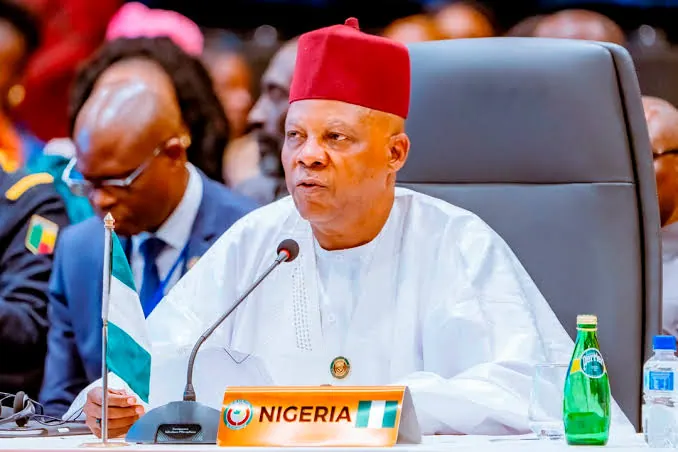
Nigeria's Vice President Kashim Shettima has called for urgent policy reforms and stronger public-private partnerships to attract domestic and foreign investment into the country's green infrastructure. He made the call at the second edition of the Decarbonising Infrastructure in Nigeria (DIN) Summit, held at the United Nations House in Abuja. The summit aimed to examine ways of closing the huge financing gap confronting Nigeria's green transition.
According to Shettima, Nigeria requires about $410 billion in additional investment by 2060 to achieve its net-zero pathway. He stressed that while the government would remain an important player in financing the transition, it could not provide all the capital required to achieve Nigeria's long-term energy and infrastructure objectives. The vice president emphasized the need for private sector involvement, development finance institutions, domestic financial institutions, and institutional investors.
Shettima identified the central issue as converting ideas, policies, and climate ambitions into projects that investors could assess, finance, and implement. He pointed out that investors would ordinarily ask questions about the policy environment, revenue model, technical issues, and risk allocation before committing capital. The vice president acknowledged that investment in green infrastructure in Nigeria faced policy, financial, technical, and institutional challenges.
The DIN Summit 2.0 brought together policymakers, development finance institutions, private investors, members of the diplomatic corps, and climate experts to address these challenges. The summit was organised by the Office of the Vice President with support from the National Council on Climate Change and United Nations Industrial Development Organisation (UNIDO). The theme of the summit was 'De-risking Green Infrastructure Investment in Nigeria: Enabling Policy, Project Readiness and Risk-Sharing Solutions'.
In a related development, power demand is surging globally, driven by higher electrification rates and the AI and data center boom. According to the International Energy Agency (IEA), the Age of Electricity is gathering pace, changing long-term assumptions and forecasts about power markets in all regions. This surge in electricity consumption poses new challenges for policymakers, power generators, and grid operators.
The United States, Europe, and the Asia-Pacific region are experiencing different pathways to meet higher electricity demand. In the US, data centers are emerging as the dominant driver of long-term electricity growth. In Europe, the European Union's decarbonization policies and drive to boost the share of renewables are driving power demand. The Asia-Pacific region is set to see the biggest power demand growth, driven by industrialization, economic expansion, and urbanization in China, India, and Southeast Asia.
However, grids globally are not ready to handle the surge in electricity loads. Global power demand is expected to grow by more than 3.5% per year on average through 2035. The need for electrons must be balanced against the risk of stranded assets, and reforms are being spurred across regional power markets to address these challenges.
Key points
- Nigeria requires $410 billion in additional investment by 2060 to achieve its net-zero pathway.
- The country's green infrastructure investment faces policy, financial, technical, and institutional challenges.
- Global power demand is surging, driven by higher electrification rates and the AI and data center boom.