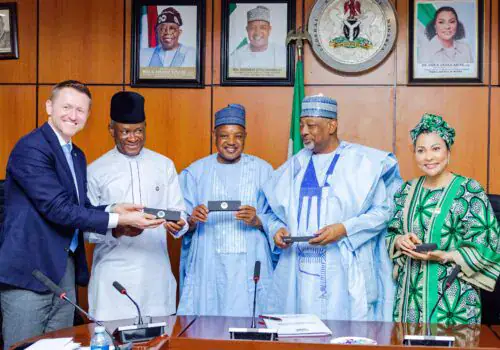
The Federal Government of Nigeria has reaffirmed its commitment to strengthening bilateral relations with Germany, focusing on economic cooperation, food security, industrial development, investment, skills acquisition, and renewable energy. This commitment was highlighted during a high-level bilateral meeting in Abuja between key Nigerian government officials and a delegation from the German Bundestag Committee on Economic Cooperation and Development.
The meeting allowed both nations to review existing bilateral partnerships, exchange perspectives on ongoing economic reforms, and identify fresh opportunities for mutually beneficial development strategies. The Nigerian delegation included the Minister of Budget and Economic Planning, Senator Abubakar Bagudu; Minister of Agriculture and Food Security, Senator Abubakar Kyari; and other senior government officials.
Senator Bagudu emphasized the need to expand trade, technology transfer, and development cooperation between Nigeria and Germany. He noted that both nations operate as federal systems, and shared experiences in economic governance could unlock significant gains in agriculture, vocational education, renewable energy, and the creative economy.
Senator Kyari detailed ongoing Federal Government initiatives to boost local food production, expand irrigation, cut post-harvest losses, and accelerate climate-resilient farming. He stressed the importance of empowering smallholder farmers, women, and youth through mechanization and agribusiness financing to strengthen rural economies.
Senator Enoh commended German development agencies, particularly GIZ, for their consistent support in technical and vocational training. He reiterated Nigeria’s focus on expanding manufacturing, supporting small and medium-scale enterprises (SMEs), and empowering young people through digital innovation.
Prof. Wolfgang Stefinger, leading the German delegation, reaffirmed Germany’s commitment to expanding cooperation in renewable energy, vocational training, healthcare infrastructure, and security. He expressed optimism that joint efforts would advance sustainable development and mutual prosperity for both nations.
The two nations are expected to enhance financing partnerships, with Nigeria seeking to adopt models like Germany’s KfW framework, to accelerate industrialization, infrastructure development, and economic stabilization efforts. This will help drive sustainable job creation and economic growth in Nigeria.
Key points
- Nigeria and Germany are strengthening bilateral ties to prioritize economic cooperation, food security, and investment.
- The two nations are exploring opportunities for mutually beneficial development strategies, including renewable energy and vocational training.
- Germany has reaffirmed its commitment to expanding cooperation with Nigeria in various sectors, including healthcare infrastructure and security.