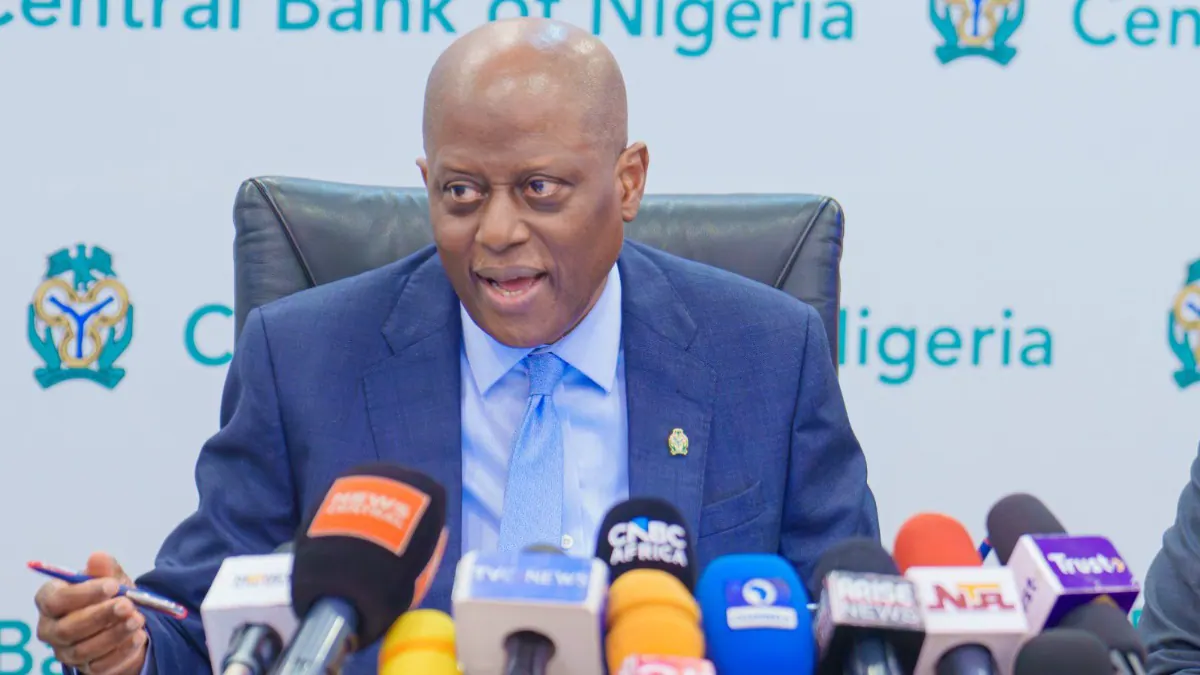
Nigeria has entered the final months of 2026 with a stronger economic position, but the Central Bank of Nigeria (CBN) warns that a tougher global environment could disrupt this improvement. The CBN's assessment was part of the Monetary Policy Committee's September 21-22 meeting, which resulted in a reset of the Monetary Policy Rate to 23 percent from 26.5 percent. The committee's outlook highlights a widening gap between improving domestic fundamentals and rising external risks.
Nigeria's external reserves have reached $55.25 billion as of September 18, the highest level in 18 years, equivalent to about 11.3 months of imports of goods and services. The current-account surplus increased from $4.49 billion in Q1 to $7.54 billion in Q2, representing a 67.92 percent increase. The overall balance-of-payments surplus rose from $2.38 billion to $3.51 billion. The CBN attributes the improvement in external buffers and receding foreign-exchange pressures to strengthened macroeconomic stability.
Domestic economic activity is also showing greater momentum. Real GDP grew 4.43 percent in Q2, up from 3.89 percent in Q1. The oil sector grew 7.31 percent from 2.57 percent, while the non-oil economy expanded 4.31 percent from 3.94 percent. August's Purchasing Managers' Index rose to 52.7 points from 51.1, signaling continued expansion in business activity. These indicators suggest that Nigeria's economy is recovering.
The disinflation trend has also strengthened the CBN's outlook. Headline inflation declined to 15.39 percent in August from 15.43 percent in July. Food inflation fell to 19.57 percent from 20.31 percent, while core inflation moderated to 13.29 percent from 14.97 percent. Month-on-month inflation slowed sharply to 0.71 percent from 1.57 percent. The CBN expects inflation to moderate further as exchange-rate stability, previous monetary tightening, and improved food supply support lower price pressures.
Despite the positive trends, the CBN warns that global economic risks could complicate Nigeria's gains. The bank projects global growth at 3.0 percent in 2026, down from 3.5 percent in 2025, citing the Middle East conflict, trade-policy uncertainty, and constrained fiscal space. Supply-chain disruptions, elevated crude and commodity prices, and increasing trade fragmentation could keep global inflation risks tilted upwards.
The CBN also highlights potential domestic risks, including prolonged Middle East tensions affecting energy prices and external-sector conditions, as well as election-related spending creating additional domestic inflationary pressure. However, the bank expects domestic output to remain resilient through the rest of 2026, supported by higher oil production, agriculture, and broader business activity.
The CBN's improved reserves, external balance, growth, and disinflation have created more policy room. Sustaining these gains will depend on how the economy absorbs shocks from both the global environment and the domestic electoral cycle. The bank's Monetary Policy Committee will continue to monitor economic trends and adjust policies as needed to maintain stability.
Key points
- Nigeria's external reserves have reached $55.25 billion, the highest level in 18 years.
- The country's GDP grew 4.43 percent in Q2, up from 3.89 percent in Q1.
- Headline inflation declined to 15.39 percent in August from 15.43 percent in July.