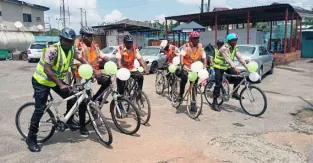
As Nigeria celebrates 66 years of independence, transportation experts and road safety advocates are calling for a redefinition of the country's mobility system. They argue that true independence cannot be achieved while millions of Nigerians remain dependent on petrol-powered vehicles for daily mobility. Instead, they advocate for greater investment in cycling, walking, public transportation, and other sustainable mobility options that are affordable and accessible.
The call for change was made during a special edition of Lagos Traffic Radio 96.1 FM's Your Side Mirror programme, which examined how cycling and other non-motorised transport options could reshape Nigeria's urban mobility system. The discussion, themed "Nigeria @ 66: True Independence Beyond Petrol," focused on the rising cost of fuel and its impact on transportation, household incomes, and economic productivity. Participants explored the potential for bicycles to become part of the solution to Nigeria's fuel challenges.
Charlotte Ward, Executive Director of the United Kingdom-based charity Re-Cycle: Bikes to Africa, highlighted the organisation's efforts to improve mobility, education, and livelihoods across Africa through bicycle distribution. Since 1997, Re-Cycle has supplied over 170,000 bicycles across the continent and has partnered with the Gabriel Rotimi Aroge Empowerment Foundation to expand access to affordable bicycles in Nigeria. However, Ward stressed that bicycles alone cannot transform urban mobility without deliberate investment in safe infrastructure.
Road safety was also a prominent topic during the programme, with Corps Commander Kehinde G. Hamzat of the Federal Road Safety Corps (FRSC) emphasising the need for adequate safety measures to protect cyclists. Hamzat proposed introducing a "Park and Ride" model in Lagos and other major cities, where commuters would cycle from their homes to Bus Rapid Transit (BRT) terminals, safely park their bicycles, and complete their journeys by public transport.
Mazi Philip Okonkwo of the Chartered Institute of Transport Administration of Nigeria (CIOTA) noted that Nigeria must overcome cultural misconceptions about cycling before meaningful progress can be achieved. He observed that walking and cycling have often been regarded as transport options for the poor, whereas developed countries have successfully integrated non-motorised transport into modern urban planning. Okonkwo recommended beginning with university campuses, residential estates, and institutional communities where travel distances are shorter and road conditions generally safer.
Rotimi Gabriel Aroge, Founder of the Gabriel Rotimi Aroge Empowerment Foundation, said the bicycle initiative originated from the United Nations Decade of Action for Road Safety 2021–2030. He stressed that sustainable cycling requires more than painting cycle lanes, and that changing the attitudes of motorists and cyclists through continuous education remains the most important factor. The foundation has introduced bicycle training and road safety education in five Lagos schools to promote safe cycling.
Charles Ekwuma of the National Centre for Energy Efficiency and Conservation (NCEEC) described bicycles, including electric bicycles, as practical, affordable, and environmentally responsible alternatives for urban commuting. He disclosed that the initiative began in Lagos, with plans for nationwide expansion. The foundation also participated in the 2026 National Council on Transport in Abuja, where proposals were presented advocating cycling in school curricula and secure bicycle parking facilities.
Key points
- Transportation experts urge Nigeria to reduce petrol dependence and adopt cleaner transport alternatives.
- Experts advocate for investment in cycling, walking, public transportation, and other sustainable mobility options.
- Nigeria's transportation system can be transformed through education, infrastructure development, and policy changes.