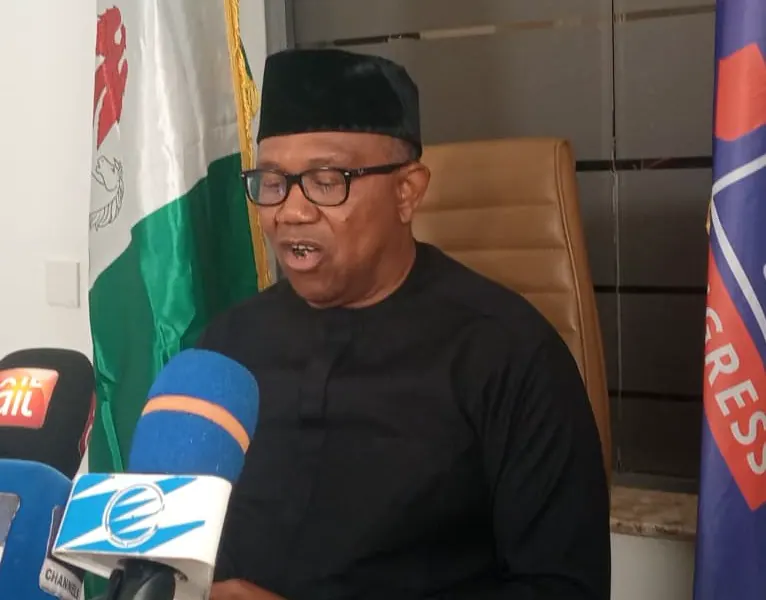
On October 1, 2026, Peter Obi, presidential candidate of the Nigeria Democratic Congress, delivered his Independence Day address to Nigerians commemorating the country’s 66th anniversary. In his address, Obi identified insecurity, poverty, unemployment, hunger, and deficiencies in critical sectors as persistent obstacles to national development. He emphasized that no Nigerian should be compelled to remain in an Internally Displaced Persons (IDP) camp due to the government's failure to provide adequate security.
Obi made a commitment to confront insecurity decisively, enabling farmers to return to their farms, children to return to school, businesses to operate freely, and families to live without fear. He stated that his administration would work to ensure that Nigerians displaced by insecurity can begin to return safely and with dignity to their communities. This commitment was reinforced by a recent visit to Sokoto State, where he and his running mate, Senator Rabiu Kwankwaso, engaged residents on some of the pressing challenges confronting the state and the country.
During their visit to Sokoto State, the delegation also visited an IDP camp at Ramin Kura in Sokoto metropolis, where they witnessed distressing living conditions. Thousands of women and children who had been forced to flee their communities were enduring harsh circumstances, with many children without access to education and mothers and their children having inadequate access to essential healthcare. Obi noted that the circumstances observed at Ramin Kura were not peculiar to the community but represented the difficulties being experienced by several communities across the country.
Obi argued that Nigeria's fundamental problem was not the absence of abundant human and natural resources but the inability of successive administrations to transform those resources into meaningful human development, higher productivity, greater security, and widespread prosperity. He highlighted the worsening socioeconomic realities facing Nigerians, citing more than 140 million people living in poverty and severe hardship, over 18 million children out of school, and more than 35 million young Nigerians affected by unemployment and underemployment.
The NDC presidential candidate also identified insecurity, terrorism, banditry, and kidnapping, food insecurity, infant and maternal mortality, drug abuse, and low life expectancy among the major problems requiring urgent attention. He emphasized the need for Nigeria to transition from a consumption-led economic model to a productive economy that would generate employment, broaden opportunities, strengthen agriculture and manufacturing, and place greater emphasis on human capital development.
Obi pledged to introduce a system of governance that would be measurable, accountable, and focused on improving the welfare and productivity of citizens. He promised that Nigerians would begin to witness concrete changes within the first year of his administration if elected. Additionally, he vowed to lead by example, spending his holidays in different parts of Nigeria rather than traveling abroad, and to create a Nigeria that was secure, united, and productive.
On the 66th Independence Anniversary, Obi called on Nigerians to reflect on the country's journey since independence, examine its present circumstances, and consider the direction the nation should pursue. He maintained that achieving the Nigeria citizens aspire to would require more than prayers and political promises, stressing the importance of leadership that regards public office as a sacred responsibility and citizens who consistently demand accountability from those entrusted with power.
Key points
- Peter Obi promises to tackle insecurity and create conditions for Nigerians displaced by violence to return to their communities safely.
- Obi identifies insecurity, poverty, unemployment, hunger, and deficiencies in critical sectors as persistent obstacles to national development.
- Obi pledges to introduce a system of governance that would be measurable, accountable, and focused on improving the welfare and productivity of citizens.