Nigeria is confronting a stark economic irony as it marks its 66th independence anniversary. Once a lender and contributor to the International Monetary Fund and the World Bank, the country now ranks among their significant borrowers, even as its revenue receipts climb year after year. Under General Yakubu Gowon, Nigeria possessed sufficient reserves to lend $240 million to the World Bank and $120 million to the IMF.
At the height of the 1970s oil boom, rising petroleum revenues strengthened Nigeria's foreign reserves and global economic position. In 1974 alone, Nigeria committed about $360 million to the two institutions. World Bank records document the arrangement as a loan from Nigeria to the bank. The country's influence extended beyond finance, with members of Saudi Arabia's royal family reportedly traveling to University College Hospital in Ibadan for treatment.
Today, the picture has reversed. Nigeria holds more than $20 billion in original International Development Association credits and about $2.85 billion in International Bank for Reconstruction and Development loans. It currently has no outstanding IMF credit after repaying its remaining financing in 2025. The transformation has been dramatic, from lender and medical destination to one of the World Bank's larger borrowers and a source of medical tourism outflow.
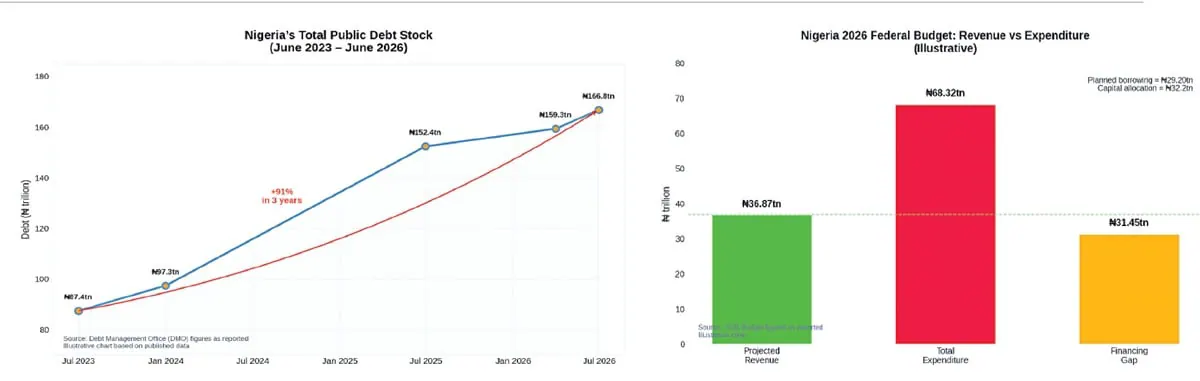
Nigeria's external debt stock has risen by about $11.4 billion since President Bola Tinubu assumed office in 2023. It expanded from roughly $43.1 billion to $54.5 billion as of June 2026. The increase reflects a preference for foreign borrowing to finance economic reforms, budget deficits and development programmes. Debt to the World Bank climbed from about $15.4 billion to $20.7 billion in the period.
Major financing approved under the current administration included $2.25 billion for economic reforms in June 2024, $1.57 billion for the HOPE and SPIN programmes in September 2024, and $1.08 billion for education and resilience programmes in March 2025. The Federal Government is seeking a fresh $1.5 billion in financing from the World Bank through three loans targeting climate resilience, early childhood development and social protection.
Nigeria returned to the international capital market in December 2024 with a $2.2 billion Eurobond and another $2.35 billion Eurobond in November 2025, bringing the total from the two issuances to $4.55 billion. The country secured a $1.8 billion syndicated loan from First Abu Dhabi Bank and agreed a $5 billion derivatives financing arrangement in 2026, of which $1.5 billion had been drawn by June.
Despite rising revenue, Nigeria's financing gap has grown. Federal Government aggregate revenue increased from N12.48 trillion in 2023 to N20.98 trillion in 2024. However, the 2026 budget provides for approximately N68.32 trillion in total expenditure against N36.87 trillion in projected revenue, producing a financing deficit of roughly N31.45–N31.46 trillion. Planned borrowing stands at N29.20 trillion, up from an earlier figure of about N17.89 trillion.
Key points
- Nigeria's external debt stock has risen by about $11.4 billion since President Bola Tinubu assumed office in 2023.
- The country's revenue growth has been driven increasingly by taxation and other non-oil sources.
- Nigeria's financing gap has grown despite rising revenue, with a projected financing deficit of roughly N31.45–N31.46 trillion in 2026.