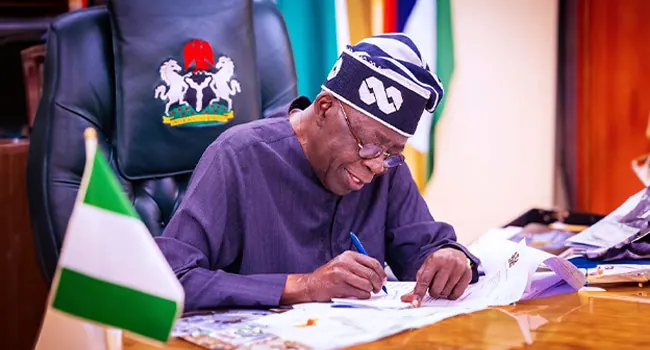
President Bola Ahmed Tinubu has declared that Nigeria has moved beyond the phase of difficult economic reforms, prioritizing the delivery of shared and widespread prosperity to citizens. In his Independence Day address, Tinubu acknowledged the hardship experienced by millions of citizens while defending the economic measures implemented by his administration since 2023. He emphasized that Nigeria had reached a turning point after three years of efforts aimed at correcting deep-rooted economic distortions.
Tinubu defended the difficult economic decisions taken by his administration, arguing that the reforms did not create Nigeria's underlying economic weaknesses but were introduced to confront them. He compared the country's pre-reform economic situation to a patient diagnosed with cancer, saying previous governments had repeatedly treated the symptoms of the problem rather than addressing its underlying causes. The President maintained that abandoning the reforms in favor of unsustainable subsidy arrangements would undermine the progress already made.
Tinubu cited economic gains, including growth of more than four percent in 2026 and contributions from both the oil and non-oil sectors. He also listed lower oil theft, a substantial decline in inflation from its peak, rebuilt foreign reserves, and greater stability in the foreign exchange market as evidence of progress. Additionally, Nigeria recorded more than $6 billion in non-oil export revenue in 2025, the highest in the country's history, demonstrating that Nigerian businesses were increasingly contributing to the country's economic expansion.
The President emphasized that reducing the cost of living would be a major priority in the next phase of his administration, with a focus on lowering the cost of producing and transporting goods. He said the government would expand mechanized irrigation and dry-season farming, improve access to seeds and fertilizer, increase agricultural mechanization, and invest in storage and transportation. Ongoing investments in roads, railways, and ports aim to improve the movement of goods between farms, factories, and markets.
Job creation and industrial expansion are also at the center of the next phase of Tinubu's administration's economic program. He stressed the need to create opportunities for young people with skills, talent, and entrepreneurial ambitions, making Nigeria's large youth population an engine of production rather than a source of frustration. The government plans to use Nigeria's gas resources to support new industries, assist businesses seeking to revive factories, expand digital connectivity, and invest in skills required by employers.
Despite emphasizing economic progress, Tinubu acknowledged that millions of Nigerians continued to face difficulties meeting basic needs. He said these challenges predated his administration and reflected the cumulative effects of decades of low productivity, inadequate infrastructure, insufficient opportunities, and institutional weaknesses. The President highlighted social intervention programs, including the Nigerian Education Loan Fund and the Consumer Credit Corporation, aimed at supporting poorer households and providing access to credit for working Nigerians.
Tinubu concluded that social intervention programs should not be regarded as the ultimate solution to poverty but as a bridge towards a more prosperous economy. He declared that the administration's objective is not to manage poverty more efficiently but to defeat it, requiring sustained economic growth and the creation of millions of productive opportunities. The President expressed confidence that Nigeria was entering a new phase from a stronger economic foundation, marking the beginning of the "age of prosperity."
Key points
- President Tinubu prioritizes shared prosperity for Nigerian citizens.
- Nigeria records over $6 billion in non-oil export revenue in 2025.
- The administration aims to defeat poverty through sustained economic growth.