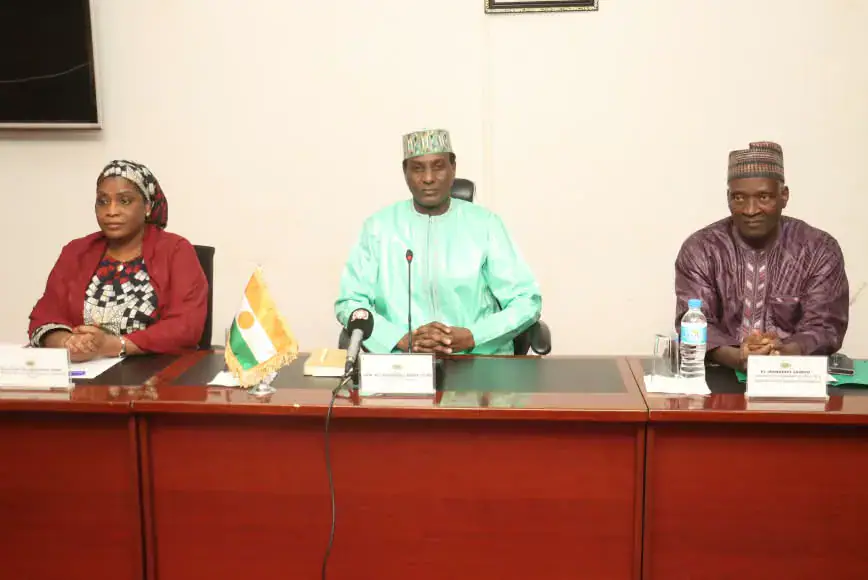
The Prime Minister of Niger, Ali Mahamane Lamine Zeine, presided over the opening ceremony of the first ordinary session of the National Labor Council (CNT) for the year 2026. The session, held on November 18, 2026, focused on four key issues related to improving working conditions and strengthening social dialogue in the country. These issues included harmonizing the legal retirement age, the functioning of social dialogue bodies, implementing the competition law, and the representativeness of trade unions.
In his address, Prime Minister Zeine emphasized that the session's agenda was centered around essential concerns. He invited council members to be available and understanding to ensure the talks took place in a serene and intelligent atmosphere. The Prime Minister also expressed hope that the conclusions from the discussions would be relevant and support the country's progress while preserving national interests. He represented President Abdourahamane Tiani, the Head of State.
The Minister of Public Service, Labor, and Employment, Aïssatou Abdoulaye Tondi, highlighted the fundamental role of the National Labor Council as an institutional framework for consultation and dialogue between the government and social partners on labor issues. She stressed that the council plays a crucial role in preventing social conflicts, finding lasting compromises, and consolidating a peaceful social climate. This, she said, is vital for the continuity of economic activities and improving the professional environment.
Minister Tondi emphasized the importance of the council's mission in the current context of Niger's refoundation. She stated that building a stronger, more resilient state requires professional relationships based on trust, responsibility, solidarity, and respect for mutual commitments. The minister then discussed the four points on the agenda, with particular emphasis on raising the retirement age to 62 for workers in the private and parapublic sectors.
According to Minister Tondi, raising the retirement age would ensure equity between different categories of workers. Similar measures have already been taken for state auxiliaries and agents governed by the General Statute of the State Public Service. She also highlighted the importance of the proper functioning of social dialogue bodies to prevent tensions and manage the concerns of social partners.
The session provided a platform for stakeholders to discuss and address workers' concerns. The National Labor Council's role in promoting social dialogue and improving working conditions is critical in Niger's current context. The council's discussions and conclusions are expected to contribute to the country's progress and development.
The government's efforts to strengthen social dialogue and improve working conditions demonstrate its commitment to promoting a peaceful social climate. The session's outcomes will likely have a positive impact on Niger's workforce and economy. Key issues, such as retirement age and social dialogue, were central to the discussions.
Key points
- The National Labor Council's session focused on improving working conditions and strengthening social dialogue in Niger.
- The council discussed four key issues, including harmonizing the legal retirement age and the functioning of social dialogue bodies.
- The session aimed to promote a peaceful social climate and support Niger's progress and development.
Reporting sources
- 1ère session ordinaire du CNT au titre de l’année 2026 : Les préoccupations des travailleurs au centre des discussions · Agence Nigérienne de Presse