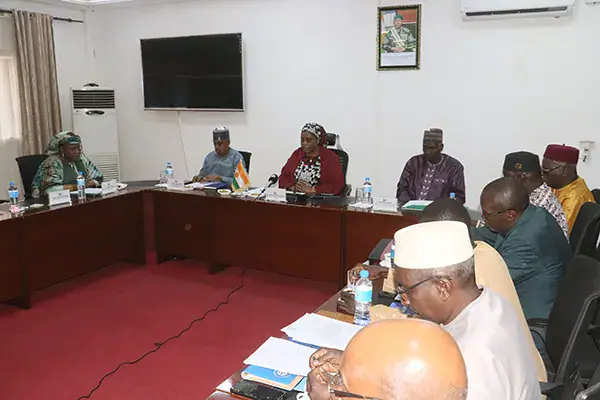
The National Labor Council of Niger held its first session of 2026 on November 18, 2026, at the Prime Minister's office. The council discussed several key issues, including raising the retirement age to 62 for workers in the private and parastatal sectors. This session was attended by Prime Minister Ali Mahaman Lamine Zeine, who is also the president of the council. The discussions aimed to address various labor-related concerns and their implications on social stability and economic functioning.
The Minister of Public Service, Labor, and Employment, Aïssatou Abdoulaye Tondi, emphasized the importance of examining the proposed increase in retirement age. She stated that this measure would ensure equity among different categories of workers, as similar provisions have already been made for state auxiliaries and agents governed by the General Statute of the State Public Service. This move is expected to create a more balanced system for workers across various sectors.
The council also addressed the issue of dysfunctional social dialogue organs and the full implementation of Law No. 2019-56, which pertains to the organization of competition in Niger. The Minister highlighted the need for concrete proposals to revitalize these organs and ensure their regular functioning. This is crucial for preventing tensions and managing the concerns of social partners effectively.
The Minister of Public Service, Labor, and Employment, reiterated the government's commitment to maintaining open and constructive dialogue with all social partners. She encouraged council members to consider the current economic and financial context while making their decisions. This approach aims to foster a collaborative environment for addressing labor-related issues.
Prime Minister Ali Mahaman Lamine Zeine expressed his appreciation for the council members and hoped that the session would yield positive outcomes for the country's progress. He emphasized the significant role of the council members and expressed confidence in their ability to conduct the discussions in a serene atmosphere.
The discussions on the retirement age and other labor issues are critical for Niger's workforce. The proposed increase in retirement age to 62 years is expected to bring the private and parastatal sectors in line with existing regulations for state workers. This move could have far-reaching implications for the country's labor policies and social security systems.
The National Labor Council's session concluded with an emphasis on the need for collaborative efforts to address the country's labor challenges. The council's decisions and recommendations are expected to contribute to the development of more effective labor policies and improved working conditions for Niger's workforce.
Key points
- The proposed increase in retirement age to 62 years for private and parastatal sectors aims to ensure equity among different categories of workers.