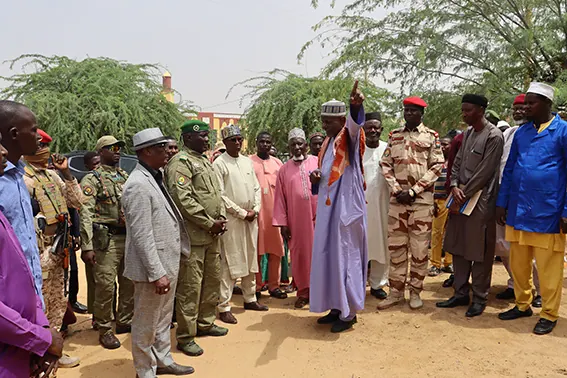
In a recent visit to the Tillabéri region, Niger's Minister of Technical and Vocational Education, Pr Farmo Moumouni, traveled to Sansané Haoussa to revisit the site of a tragic event in the country's history. On October 1, 2026, the minister, accompanied by the region's governor, Colonel Maïna Boukar, and other officials, explored the local area and gathered information about the Voulet-Chanoine mission that passed through the region in the late 19th century.
The Voulet-Chanoine mission, also known as the Central Africa mission, departed Djenné on October 18, 1898, as part of the French expansion into territories between the Niger River and Lake Chad. Historical records document the mission's passage through Sansané Haoussa in early January 1899, during which violence was committed against local populations. According to a recent UN source, a massacre occurred on January 9, 1899, and the mission implemented a policy of requisitions and violence.
During his visit, Minister Moumouni met with Harouna Idrissa dit Tazief, a local resident who shared a testimony passed down through oral tradition. The account describes the local population's resistance to the advancing French column and the subsequent violence and destruction inflicted upon the community. While such testimonies must be distinguished from documented historical facts, they form an essential part of the collective memory preserved in Sansané Haoussa.
The minister's visit focused on the old cement granaries still standing in the locality, which are attributed to the Voulet-Chanoine mission. Moumouni stated that his mission aims to gather elements to better document a particularly painful period in Niger's history. He emphasized that the delegation was mandated by the President of the Republic to retrace the route of this tragedy, which will take them from N'Guigmi to Sansané Haoussa.
The visit to Sansané Haoussa allowed the minister and his delegation to examine three key aspects: the physical traces preserved on site, historical documents related to the mission, and the local memory carried by the inhabitants. This multifaceted approach enables a more comprehensive understanding of this dark chapter in Niger's history.
As part of their itinerary, the minister and his delegation also paid a courtesy visit to the chief of the Kourthey canton, Honorable Ali Hassane Yori. This meeting underscores the importance of collaboration and dialogue with local leaders in preserving and understanding the country's history.
The minister's initiative demonstrates a commitment to preserving Niger's history and promoting a deeper understanding of the country's complex past. By retracing the steps of the Voulet-Chanoine mission, Minister Moumouni and his delegation aim to shed light on a painful period and foster greater awareness among the Nigerien people.
Key points
- The Voulet-Chanoine mission's passage through Sansané Haoussa in January 1899 was marked by violence and destruction against local populations.
- Minister Moumouni's visit aimed to gather information and document the tragic events of the Voulet-Chanoine mission.
- The delegation's itinerary includes traveling from N'Guigmi to Sansané Haoussa to retrace the route of the Voulet-Chanoine mission.