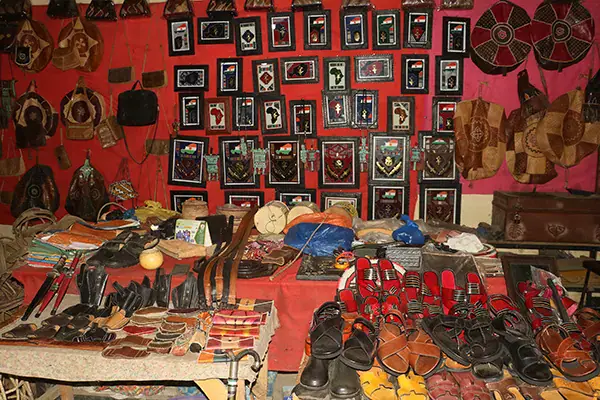
Located at the entrance of Maradi, Niger, the artisanal center is home to various craftsmen, including leatherworkers, jewelers, dyers, and carpenters. The center was established in March 1997 with the support of the Nigerien government's program to develop the country's artisanal sector. It aims to promote and valorize local know-how through diverse productions. The center comprises several workshops and stores where artisans create and sell their products.
The center's cooperative, led by Salah Amzak, was initially composed of 120 members, including 50 women and 70 men. The women primarily focused on leatherwork, while the men worked in metal founding, metal carpentry, leatherwork, and shoemaking. The cooperative has received support from the Luxembourgish cooperation until 2004. Amzak explains that the artisans participate in national and international meetings and training sessions to enhance their skills and discover new craftsmanship techniques.
Despite their creative endeavors, the artisans face significant challenges in selling their products, largely due to the security situation in the Sahel region. Salah Amzak notes that the insecurity has created a climate of uncertainty, making people hesitant to travel. He encourages Nigeriens to support local products to promote the development of the national artisanal sector. The cooperative is exploring initiatives to encourage local purchases and promote "Made in Niger" products.
Chaïbou Moussa, a master dyer and secretary general adjoint of the cooperative, has introduced innovative techniques, such as batik on leather, to the center. He aims to valorize local leather, particularly from the Maradi red goat, using vegetable dyes. Moussa has acquired exceptional know-how through training and experience, having worked with leatherworkers and followed training sessions with artisans from Guinea-Bissau and Conakry.
Moussa's passion for dyeing was inspired by his family and early training. He began his career in 1992 and has since formed over 368 apprentices, including young people during school vacations and students in professional schools. His dedication to sharing his expertise has contributed significantly to the development of the artisanal sector in Maradi.
The artisanal center's cooperative continues to work towards promoting local craftsmanship and encouraging the consumption of "Made in Niger" products. Salah Amzak invites the Nigerien government to pursue its policy of promoting local products and to strengthen its efforts to ensure peace and security, which are essential for the sector's growth.
The artisans at Maradi's artisanal center remain optimistic about the future, driven by their passion for their craft and their commitment to preserving local traditions. As they continue to create innovative products, they hope that their efforts will be supported by local consumers and the government, ultimately contributing to the development of Niger's economy.
Key points
- The artisanal center in Maradi, Niger, faces challenges in selling products due to security concerns in the Sahel region.