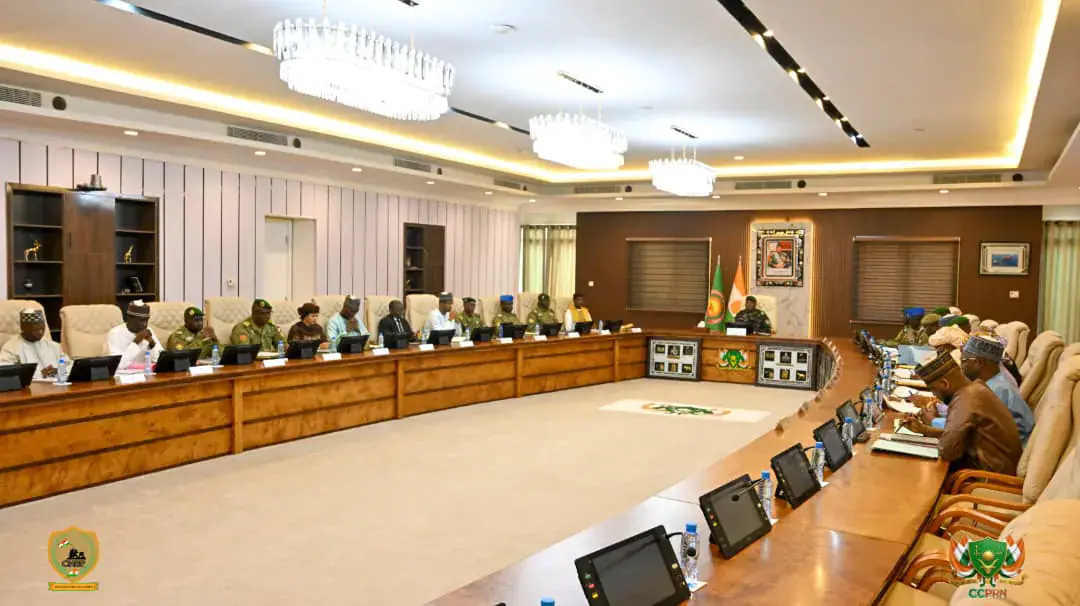
The Nigerien government, under the leadership of General Abdourahamane Tiani, has adopted a series of significant reforms aimed at accelerating the country's development. On October 29, 2026, the Council of Ministers approved the creation of a national railway transport company, Société nigérienne de transport par rails (SNTR), as part of the strategy to develop the railway sector within the Alliance of Sahel States (AES). This new entity will manage railway traffic while ensuring safety and security standards.
In a move to promote local consumption, the Council established the Observatoire national du « Consommons nigérien » (ONCN), an intersectoral body under the direct authority of the Prime Minister. The ONCN will collect and analyze data on local consumption, evaluate public policies and private initiatives, and propose strategic orientations to promote local products, goods, and services. The observatory will comprise representatives from the public sector, private sector, and civil society.
The Council also adopted several decrees related to civil aviation, including the creation of the Organe de coordination de la sûreté et de la facilitation de l'aviation civile (OCSF). This new body will be responsible for coordinating and implementing aviation safety and security measures, while the Autorité nationale de l'aviation civile du Niger (ANAC-Niger) will focus on supervision. The Council also redefined the roles of the Comité national de sûreté de l'aviation (CNSA) and the Comité national de l'environnement des aéroports (CNEA).
In the education sector, the government created a Centre régional des œuvres universitaires (CROU) in each regional capital to improve the management of university services and accelerate decision-making. An Agence nigérienne des bourses (ANB) was also established. Additionally, the Council modified the ordinances of three road sector establishments: the Agence de maîtrise d'ouvrage déléguée de l'entretien routier (AMODER), the Fonds d'entretien routier (FER), and the Centre de perfectionnement des travaux publics (CPTP).
The Council also made significant decisions regarding public enterprises, including the nationalization of the Société Niger-Transit (NITRA) and the transfer of its technical tutelage to the Minister of Finance. The modalities for managing the fund dedicated to the Mont Égalagh de Timia natural reserve were also defined. Furthermore, the Council was informed of several public contracts, including the bitumization of the Arlit-Assamaka-Algerian border road and the construction of the Bamako-Ouagadougou-Niamey highway.
In recognition of its good governance in the mining sector, Niger was distinguished at the 22nd Annual General Assembly of the Intergovernmental Forum on Mining (IGF) in Geneva. The country was among eleven nations nominated for the excellence prize in mining governance. This recognition encourages Niger to continue making sovereign choices about its natural resources for the benefit of its citizens.
The government also reported on the success of the first edition of Abinci'Niger, the National Gastronomy Salon, which took place in Niamey from October 16 to 18. The event attracted over 10,000 visitors, generated 120 million FCFA in declared turnover, and featured 100 stands and 74 local dishes. The Council was also informed of the installation of a 64-barrette scanner at the N'Gourti Departmental Hospital.
Key points
- Niger creates a national railway transport company to improve safety and efficiency.
- The government establishes an observatory to promote local consumption and economic development.
- Niger is recognized for its good governance in the mining sector at the IGF Assembly in Geneva.