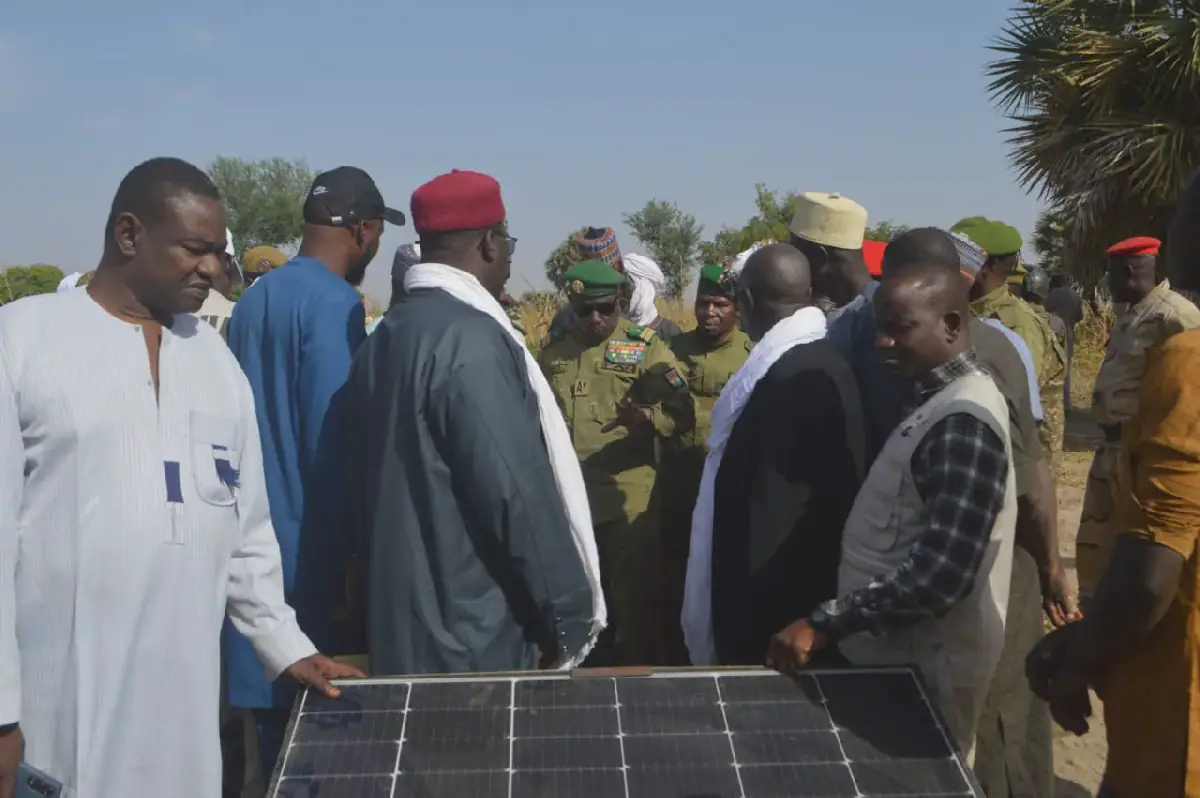
On November 20, the Governor of Niger's Dosso region, Colonel-major Bana Alhassane, visited the Falmey department to inspect sites benefiting from the Grande Irrigation program. He was accompanied by the Director General of the National Office for Hydro-Agricultural Development (ONAHA), the Director General of Rural Engineering, regional agriculture and livestock officials, and defense and security forces. The visit focused on two irrigated sites covering 18 hectares, equipped with 10 solar-powered boreholes.
The sites have seen effective exploitation of the infrastructure, with farmers engaged in irrigation activities using solar energy. Each borehole has an average depth of 6 meters and a flow rate of about 5m³ per hour. The solar-powered irrigation system allows farmers to work from 7 am to 5 pm, significantly improving their working conditions. This has alleviated the difficulties faced by farmers in obtaining fuel for their motor pumps.
Abass Abdoul Moumouni, president of the Gomni Gorou group, expressed his satisfaction with the hydraulic infrastructure. He noted that the solar-powered boreholes have enabled them to increase their production and improve their working conditions. Moumouni thanked the President of the Republic for the initiative and pledged to work towards further increasing production.
The Governor of Dosso region emphasized that the Grande Irrigation program is part of the President of the Republic's socio-economic development initiative. The program aims to provide 1,000 equipped boreholes across the Dallol Bosso region. The Governor highlighted that the first results of the program are already visible, with water flowing abundantly across the region.
Colonel-major Bana Alhassane expressed his gratitude to the President of the Republic, General Abdourahamane Tiani, for the initiative. He urged the beneficiaries to intensify their efforts to maximize the benefits of the program. The Governor's visit demonstrates the government's commitment to improving agricultural productivity and supporting local communities.
The Grande Irrigation program has brought significant relief to farmers in the Dosso region, who previously faced challenges in accessing fuel for their motor pumps. The solar-powered irrigation system has not only improved their working conditions but also increased their production capacity. The program is expected to have a positive impact on food security and the local economy.
The successful implementation of the Grande Irrigation program in the Dosso region is a testament to the government's efforts to promote agricultural development and improve the livelihoods of local communities. The program's expansion to other regions is expected to have a significant impact on Niger's agricultural sector and contribute to the country's economic growth.
Key points
- The Grande Irrigation program has provided 1,000 equipped boreholes across the Dallol Bosso region.