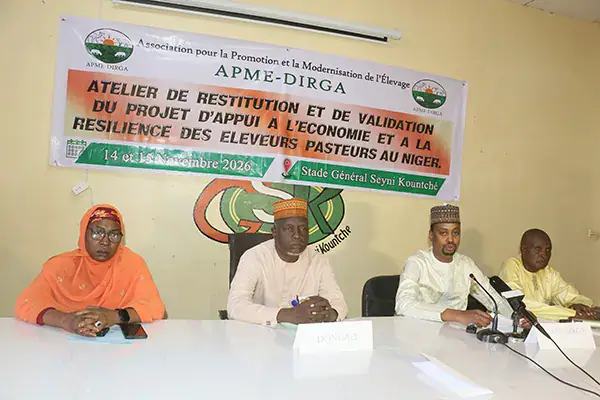
The Association for the Promotion and Modernization of Livestock (APME-DIRGA) recently held a 2-day workshop to validate its project supporting the economy and resilience of pastoralists in Niger. The event, which took place on November 14, 2026, aimed to establish a participatory approach that includes government technical services, development partners, customary authorities, and pastoralist representatives. The workshop was presided over by the Director of NGO and Development Association Monitoring at the Ministry of Interior.
The project aims to provide concrete, sustainable, and adapted responses to the insufficiency of fodder and water resources, as well as constraints related to the valorization and commercialization of pastoral products. During the workshop, participants discussed the results of preparatory work, diagnostics, and strategic axes of the project. The Director of NGO and Development Association Monitoring at the Ministry of Interior, Insa Hassane, noted that the initiative is a positive example for the pastoral livestock sector, which is a major pillar of Niger's economy despite facing difficulties.
Insa Hassane emphasized the importance of the workshop, stating that it promotes transparency, accountability, and synergy of action, ensuring local appropriation and sustainability. He assured APME-DIRGA and other associations of the government's support in respecting regulatory texts and improving the quality of their interventions. Hassane encouraged participants to contribute actively to the discussions, focusing on constructive exchanges oriented towards action in favor of pastoralists in Niger.
Ahmed Bello, President of APME-DIRGA, highlighted the association's mission to accompany the positive transformation of livestock in Niger, placing pastoralists at the heart of development. He noted that pastoral livestock is a vital part of the national economy and the foundation of life for millions of families. However, pastoralists face significant challenges, including climate-related risks. Bello emphasized that the project aims to strengthen the economic capacities of pastoral households, support the modernization of their practices, and improve access to services and markets.
The project seeks to consolidate the resilience of pastoralists in the face of climate and economic shocks. Bello invited participants to provide observations, constructive criticism, and recommendations to enrich the project document and align it with national priorities and the real expectations of local populations. The workshop provided a platform for stakeholders to engage in discussions and contribute to the project's development.
The event marked an important step in the implementation of the project, which aims to support the economy and resilience of pastoralists in Niger. APME-DIRGA's initiative is expected to have a positive impact on the lives of millions of people dependent on pastoral livestock. The project's success will depend on the collaboration and commitment of all stakeholders involved.
The workshop's outcome will inform the project's finalization and implementation. APME-DIRGA's efforts to support pastoralists in Niger are crucial, given the sector's significance to the country's economy and the challenges faced by pastoralist communities. The project's focus on sustainability and local appropriation will be essential in ensuring its long-term impact.
Key points
- The project aims to strengthen the economic capacities of pastoral households and improve their resilience to climate and economic shocks.