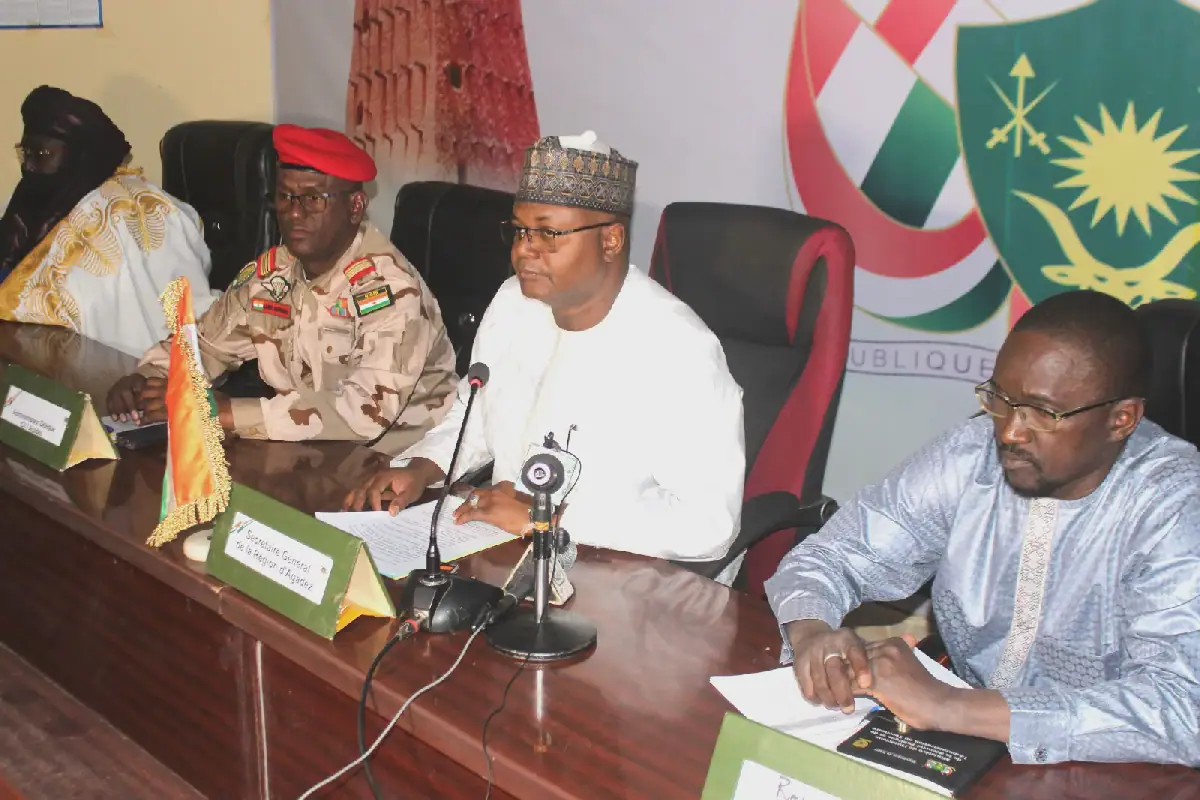
The workshop, which opened on November 17, 2026, was presided over by Souleymane Saïdou Boulhassan, Secretary General of the Agadez Regional Government. The event brings together participants to discuss the implementation of a regional operational monitoring system, including a regional monitoring committee with clearly defined responsibilities. The committee will identify regional priorities based on needs expressed by local communities, particularly women, youth, and populations in remote areas.
During the three-day workshop, participants will work on establishing a realistic program for 2026 and 2027, outlining activities, responsibilities, and a calendar compatible with available resources. They will also define clear modalities for coordination, risk management, and accountability, taking into account ongoing initiatives and local tensions. The Secretary General emphasized that the Agadez region faces similar challenges to Tahoua and Tillabéri in terms of security, access to basic social services, and institutional functioning.
Souleymane Saïdou Boulhassan noted that the state's response to these challenges must be coherent, territorialized, and sustainable, aiming to strengthen the presence and effectiveness of administration, consolidate trust between populations and institutions, and create conditions for a gradual return to stability. He stressed that community stability cannot be achieved without a strong territorial administration, functional local institutions, and active community participation in decision-making.
The Socio-Economic Stability and Recovery Project (2026-2030) is an opportunity to strengthen territorial governance, improve intervention coordination, and consolidate the role of administrative authorities in conflict prevention and community stability. The Secretary General highlighted three major imperatives guiding the workshop: institutional appropriation and responsibility, effective coordination, and efficient monitoring.
The establishment of a regional monitoring committee is expected to provide a functional governance mechanism capable of ensuring effective coordination among stakeholders. Participants will also focus on identifying hierarchized regional priorities based on expressed needs, particularly from women, youth, and remote communities.
The workshop's outcome is expected to contribute to the project's overall goal of enhancing stability and socio-economic recovery in the Agadez region. By strengthening governance and coordination, the project aims to create a conducive environment for sustainable development and improved living conditions for local populations.
The Secretary General's emphasis on institutional appropriation and responsibility underscores the importance of local authorities and stakeholders taking ownership of the project's implementation and monitoring. The workshop's success will depend on the active participation and commitment of all stakeholders involved.
Key points
- The workshop aims to establish a regional monitoring committee to oversee the implementation of the Socio-Economic Stability and Recovery Project (2026-2030).