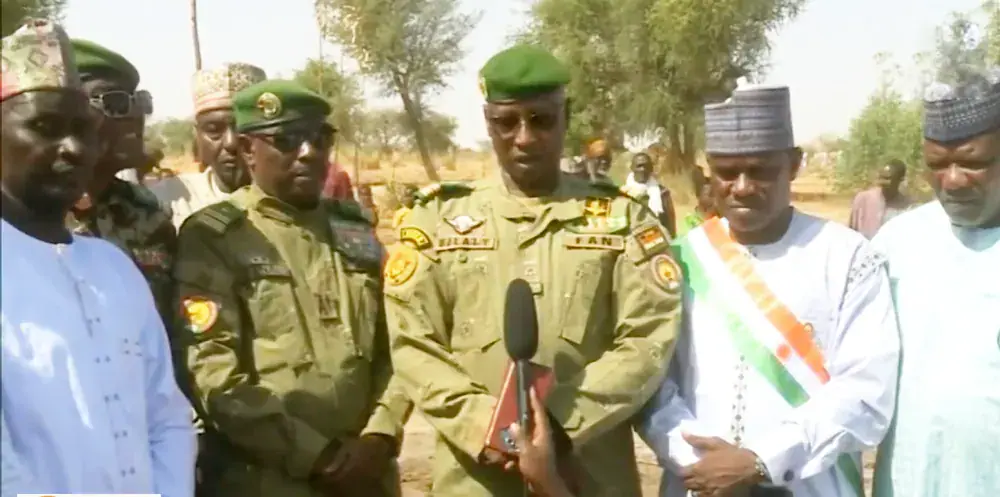
The Minister of Agriculture and Livestock, Colonel Bilaly Elhadji Gambobo, officially launched the installation of 1,000 solar-powered boreholes in the Boboye region of Dosso, Niger. This initiative aims to strengthen food production in the area and fulfill a promise made by President Abdourahamane Tiani. The launch was attended by regional authorities, including Governor Colonel-Major Bana Alhassane, and representatives from the Office National des Aménagements Hydro-Agricoles (ONAHA) and other stakeholders.
The boreholes are being installed in two sites, one with a 5-hectare area and the other with a 10-hectare area. The first site has three boreholes with a flow rate of 5m³ per hour, benefiting around 60 producers. The second site has four boreholes with a flow rate of 4.5m³ per hour, supporting approximately 100 producers, including 70 women. The project is expected to be completed by mid-December or by December 20 at the latest.
This initiative is part of the government's efforts to achieve food sovereignty and is considered a groundbreaking project in agricultural development. According to project officials, this is the first time 1,000 boreholes have been installed in a single locality. The project aims to enable producers to cultivate land outside of the rainy season and harness the region's substantial groundwater resources.
The installation of the solar-powered boreholes is aligned with the government's Grande Irrigation Program (PGI), launched in March 2024, which aims to rehabilitate 10,000 hectares of existing irrigation schemes and develop 21,200 hectares of new land. The program seeks to produce at least 481,500 tons of rice paddy per year by 2027 and reduce imports of rice, maize, and wheat by 50%.
The region of Dosso is a key area in this strategy, with the aim of making it Niger's "rice granary". In May 2024, work began on rehabilitating the 32km Gatawani dike, which protects 3,000 hectares, as well as other irrigation schemes. The solar-powered boreholes in Boboye complement this approach by providing small- and medium-scale irrigation, enabling producers to cultivate land near their villages.
Colonel Bilaly Elhadji Gambobo, formerly the director of ONAHA, has been tasked with leading the implementation of the Grande Irrigation Program. He has expressed his commitment to achieving the goal of increasing rice production and reducing imports. The minister's familiarity with the program and his experience in leading ONAHA make him well-suited to oversee the launch of this initiative.
The project has been welcomed by local authorities and producers, who see it as a vital step towards improving food security and achieving self-sufficiency in rice production. The initiative is expected to have a positive impact on the local economy and improve the livelihoods of farmers and their communities.
Key points
- The installation of 1,000 solar-powered boreholes in Boboye is a key component of Niger's strategy to achieve food sovereignty and increase agricultural production.
Reporting sources
- Niger : 1 000 forages solaires pour le Boboye · Nigerdiaspora - Niger